What’s the Latest on ALS Research and Clinical Trials?
617-724-3914
Key takeaways
- Mass General Brigham is helping to lead the next generation of ALS research. Our experts study how to diagnose ALS earlier, slow or prevent progression, restore function, and improve daily life.
- People with ALS have access to a broad range of research opportunities at Mass General Brigham. Our Sean M. Healey & AMG Center for Integrated ALS Care and Discovery offers several active clinical and lab-based research studies, including medication, cell therapy, assistive technology, biomarker, and quality-of-life research.
- The HEALEY ALS Platform Trial accelerates the search for treatments nationwide. This innovative trial evaluates multiple therapies more quickly and has already advanced promising drugs to further testing.
- Cutting-edge technology may help people with ALS maintain communication and independence. Research, such as BrainGate, is exploring how brain-computer interfaces can help people with ALS control devices and communicate using brain signals.
- Patients and caregivers are essential partners in progress. Mass General Brigham connects families with clinical trials, expanded-access programs, expert guidance, educational resources, and updates—while participation today helps build better treatments for the future.
Treating amyotrophic lateral sclerosis (ALS) was a challenge well before 1939 when baseball player Lou Gehrig brought global attention to the nervous system disease. But with exciting new momentum in research and clinical trials for ALS, physician-scientists are hopeful about current and future treatments.
“We are at a turning point because we have a greater awareness of ALS, more funding and research, and more treatments in development than ever before,” says Sabrina Paganoni, MD, PhD, a Mass General Brigham Neuroscience Institute physician-scientist, specializing in physical medicine and rehabilitation.
Dr. Paganoni serves as the Robert H. Brown, Jr., MD, PhD endowed chair in Neurology and co-director of the Neurological Clinical Research Institute. She leads clinical trials at the Sean M. Healey & AMG Center for Integrated ALS Care and Discovery and highlights a few exciting developments in ALS research across Mass General Brigham.
What is ALS?
ALS affects motor neurons, nerve cells that control the muscles responsible for how you move, swallow, and breathe. ALS is a progressive disease, meaning symptoms get worse over time.
In most cases, doctors don’t know what causes ALS. Researchers have identified more than 40 gene mutations linked to the condition, but only about 10% of people with ALS have one of these gene changes.
What are the goals of research on ALS?
“Understanding the reasons why some people get ALS is a key research focus that will eventually help doctors stop it before it starts,” says Dr. Paganoni. Researchers are also looking for ways to help patients and their families navigate symptoms.
Most ALS research aims to:
- Diagnose patients earlier, treating them sooner and leading to better outcomes.
- Slow or stop disease progression to help improve quality and length of life.
- Prevent disease for people who are genetic carriers by intervening before symptoms occur.
- Reverse disease by finding ways to restore function, such as regenerating damaged nerves.
- Use assistive technology to improve communication and movement.
The latest breakthroughs in ALS research led to new medication for ALS approved by the U.S. Food and Drug Administration (FDA) in 2023. Tofersen (Qalsody®) targets a mutation of the superoxide dismutase 1 (SOD1) gene. According to the ALS Association, this gene mutation is found in 10%-20% of people with familial (or inherited) ALS (fALS) and 1%-2% of people with no family history of the disease.
“This medication is remarkable in terms of slowing the progression of the disease for some people. We’re hoping this will be the first of many more treatments targeted to genetic mutations or other specific mechanisms,” says Dr. Paganoni.
Merit Cudkowicz looking into a microscope while Sandeep Aryal looks on.
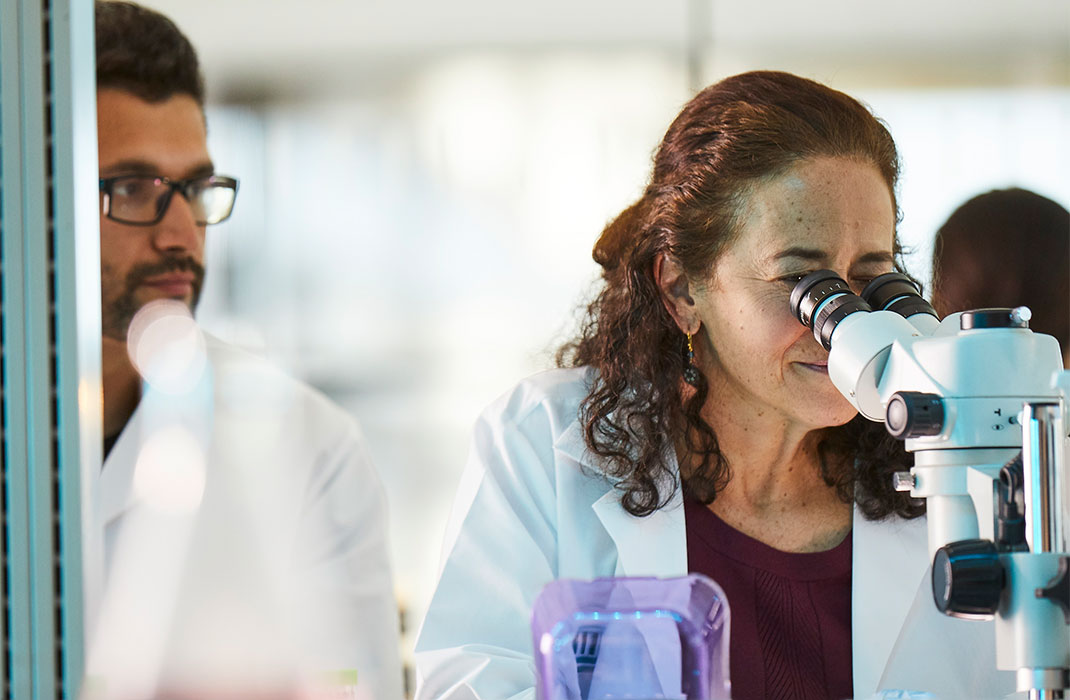
Merit Cudkowicz, MD, MSC, (right), serves as director of the Sean M. Healey & AMG Center for Integrated ALS Care and Discovery. Sandeep Aryal, PhD, (left), a postdoctoral fellow, conducts research inside the center, which is the largest hospital-based ALS research program in the United States.
"This is the right time to engage with ALS research. Clinical trials and research studies can give people with ALS the best possible tools to fight the disease now. Your collaboration also will help develop more treatments in the future."

Sabrina Paganoni, MD, PhD
- Endowed chair in Neurology and co-director of the Neurological Clinical Research Institute, Mass General Brigham
HEALEY ALS Platform Trial
To accelerate the discovery of new treatments for ALS, Mass General Brigham launched the HEALEY ALS Platform Trial in 2020. Led by Merit Cudkowicz, MD, MSc, executive director of the Mass General Brigham Neuroscience Institute, and Dr. Paganoni, the trial is coordinated by the Healey & AMG Center for ALS and designed in partnership with the Network of Excellence for ALS (NEALS) Consortium. Patients can participate at more than 70 sites throughout the United States, including leading academic medical centers and community practices.
So far, more than 1,600 people have participated in the platform trial. Seven drugs have completed testing, and one additional drug is currently being evaluated. This collaborative effort with research partners from the industry, non-profit foundations, and patient groups has already paved the way for new therapies and helped move two promising drugs to the next phase of testing.
In 2025, Dr. Cudkowicz received a lifetime achievement award from the American Academy of Neurology for her decades of significant contributions to ALS research and her work leading the platform trial.
Mass General Brigham researchers discuss ALS research.
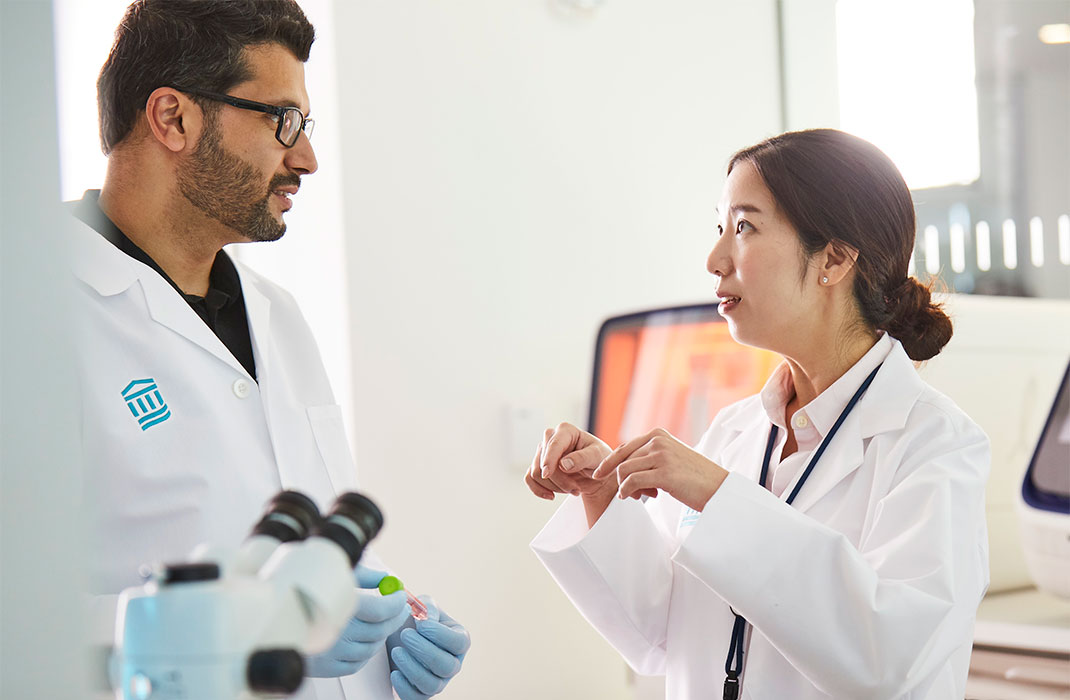
Sandeep Aryal, PhD, (left) and Su Min Lim, PhD (right), instructor in Investigation at Mass General Research Institute, discuss findings inside the Sean M. Healey & AMG Center for Integrated ALS Care and Discovery. The center offers more than 70 clinical and lab-based active research studies.
ALS clinical trials at Mass General Brigham
In addition to the HEALEY ALS Platform Trial, several ALS clinical trials and research studies at Mass General are enrolling participants. These studies hope to:
- Evaluate new medications and cell therapies.
- Create a library of biofluid samples for use in future research.
- Develop technology to help people control assistive devices without the use of their hands.
- Guide clinical recommendations to maximize physical functions such as neck support and exercise.
- Prevent disease in certain hereditary forms of ALS.
- Target programs and resources to improve quality of life.
- Test smartphone apps used for the collection of patient data.
- Develop new ways to diagnose and monitor ALS, such as new biomarkers.
“This is an exciting time to take part in clinical research and there are many more options than ever,” says Dr. Paganoni.
PREVAiLS: Pridopidine study for early, rapidly progressive ALS
In early 2026, a new Phase 3 clinical trial begins recruiting participants to test the drug pridopidine in people with early, rapidly progressive ALS. The trial, called PREVAiLS, emerges from previous research in the HEALEY ALS Platform Trial.
The PREVAiLS study aims to confirm the results of the HEALEY ALS trial in those with rapidly progressive ALS diagnosed in the past 18 months. “This study tests a much-needed new treatment option for ALS focused on therapeutic priorities—slowing of functional decline, maintaining speech, and prolonging survival,” says Dr. Paganoni, who is a PREVAiLS Steering Committee member and investigator.
In addition to the PREVAiLS study, an expanded access program offers pridopidine to people who aren’t eligible to participate in the clinical trial. The Sean M. Healey & AMG Center for Integrated ALS Care and Discovery at Mass General runs the program. Expanded access programs give patients access to critical treatments and contribute valuable efficacy and safety data to the research.
Access for All in ALS (ALL ALS)
The Accelerating Access to Critical Therapies for ALS Act of 2021 established a national clinical research consortium in 2023. ALL ALS is led by James Berry, MD, MPH, in collaboration with Suma Babu, MD, MPH, MBBS, and Dr. Paganoni, along with investigators at three other academic medical centers. The consortium collects and organizes samples and data from people with ALS and people at increased genetic risk for ALS.
“The goal of the consortium is to develop the largest data set and biosample repository from people living with ALS. This will lead to many discoveries,” says Dr. Paganoni.
BrainGate Neural Interface System
Leigh Hochberg, MD, PhD, director of the Center for Neurotechnology and Neurorecovery at Massachusetts General Hospital, is director of the BrainGate Consortium and clinical trials.
BrainGate is trying to determine if a device implanted in the brain can help people with ALS control assistive devices with thought. The technology is targeted to people who have lost the use of their limbs or their ability to speak, including those with neurologic diseases such as ALS and beyond.
In a recent clinical trial, BrainGate researchers tested an implantable brain-computer interface that helped a 45-year-old patient with ALS successfully communicate again. The interface “decoded” the patient’s brain signals as he attempted to speak and used artificial intelligence to create a computer-generated version of his own voice.
Healey ALS MyMatch
In 2025, the Healey & AMG Center launched the Healey ALS MyMatch program. Led by Suma Babu, MBBS, MPH, ALS MyMatch is a multisite, early-phase (Phase 1b/2a) clinical trial program in ALS.
To date, the program has received 17 applications from drug developers and has accepted nine. The first MyMatch clinical trial, ACACIA trial, was completed and announced results in September 2026. The second trial, BANYAN trial, is currently enrolling participants. Four additional trials have completed trial design and are pending regulatory approvals for initiating enrollment.
In the program, series of independent clinical trials of gene-targeted and an array of other investigational therapeutics are designed and conducted using custom trial designs to meet the scientific objectives of each trial. A common screening protocol allows for participants to screen once, undergo genetic and biomarker profiling, and that information is then used to match to the right trial in the program. By prioritizing high-quality biomarker-driven target engagement and dose-finding information in early-phase clinical trials, ALS MyMatch paves the way for efficient therapeutic development in ALS.
Data from successful ALS MyMatch trials will inform future late phase clinical trial design via the HEALEY ALS Platform Trial or a standalone Phase 2/3 trial.
Where do I find more information about clinical trials for ALS?
“This is the right time to engage with ALS research. Clinical trials and research studies can give people with ALS the best possible tools to fight the disease now. Your collaboration also will help develop more treatments in the future,” says Dr. Paganoni.
Start by talking to your doctor, who can offer guidance about the most appropriate research options for your circumstances. For more details about research opportunities and updates about treatment options at Mass General Brigham:
- Visit our ALS research page for a detailed list of current trials and studies and to apply.
- Register for ALS Link, a newsletter with clinical care information from ALS experts at the Healey & AMG Center for ALS and updates about the HEALEY ALS Platform Trial and other research.
- Register for ALS webinars for weekly discussions about the platform trial and other helpful topics.
Working together, the outlook for ALS treatment is hopeful, says Dr. Paganoni.
“We need to keep the momentum going, with more funding, more initiatives, and continued participation from the ALS patient community, so that we can make progress together.”
ALS clinical trials and research
The Sean M. Healey & AMG Center for Integrated ALS Care and Discovery leads one of the most active ALS research programs in the world, with several studies underway at any time. Our teams focus on developing new treatments, improving biomarkers, and designing more efficient clinical trials to move promising therapies forward.
Our goal is to accelerate the development of treatments that slow, stop, and one day prevent ALS. Our integrated model brings together scientists, clinicians, engineers, and people living with ALS to move discoveries from the laboratory into clinical trials.
Research includes cell and gene therapies, targeted antibodies, and small-molecule treatments, with the goal of slowing or stopping the disease. Because ALS affects each person differently, we use precision medicine approaches to help match treatments to each person’s biology.