Facing Colorectal Cancer with a Healthy Attitude Backed by Cutting-Edge Medical Care
Chris Kowalski of Hanover, Massachusetts, seemingly had it all. At age 37, he had a loving wife, a nearly two-year-old daughter and a baby boy on the way, and a fulfilling career in medical sales.
A former baseball and basketball player at Boston College, Chris had always stayed active. A self-described "energetic guy with a high motor," he ran or lifted weights five or six days a week.
When he began feeling severely tired most days, he wasn't too concerned. A quick nap usually left him refreshed. But then a nagging pain emerged in his right upper ribcage.
After a few weeks of dealing with the pain, Chris made an appointment with his long-time primary care doctor at Mass General Brigham, Allan Pineda, MD. An examination of the ribcage area didn't find anything unusual. Just to be safe, though, Dr. Pineda referred him for a CT scan.
It was a decision that saved Chris' life.
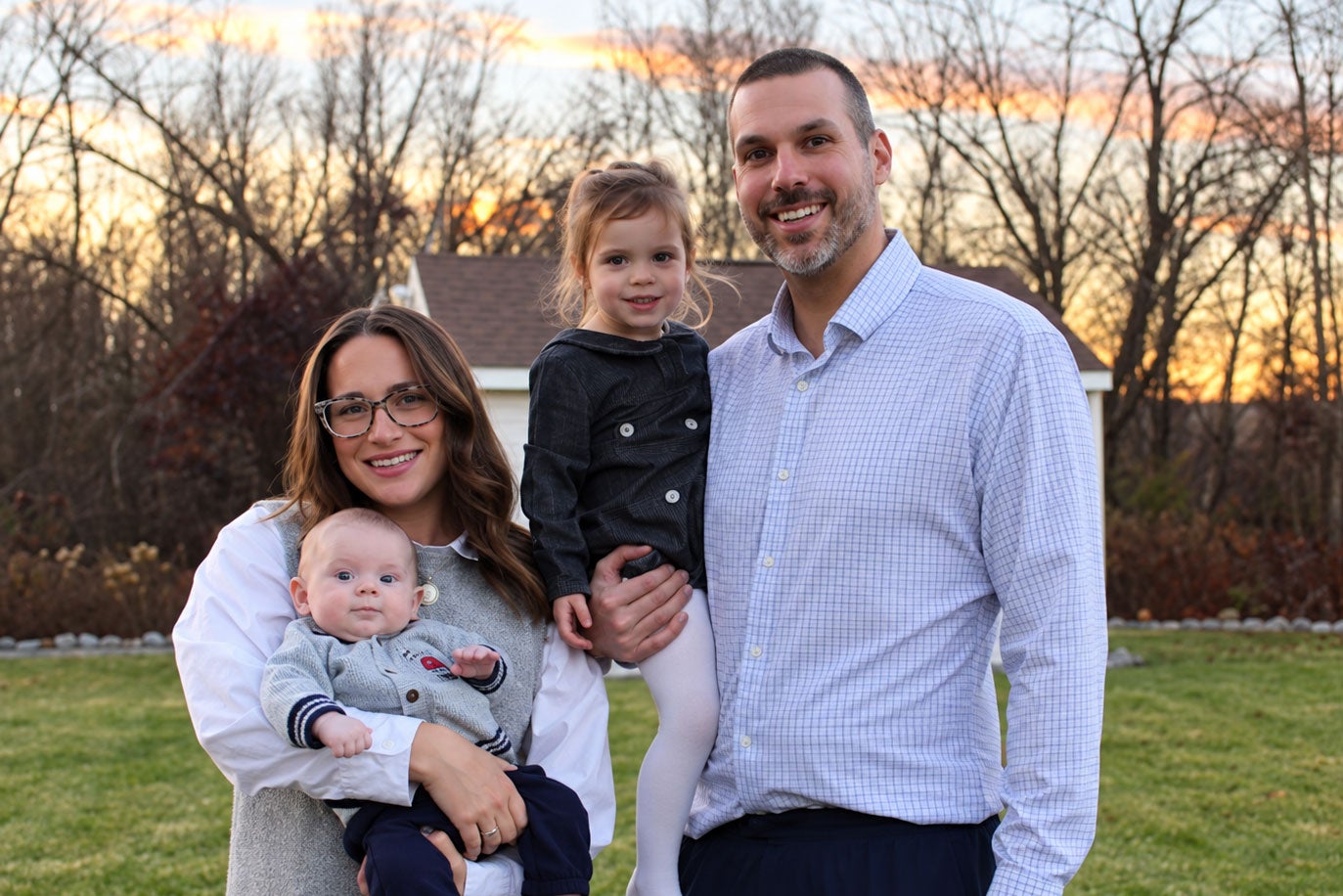
Receiving grim news on the golf course
Three days later, Chris had the CT scan done at Mass General Brigham Imaging (Chestnut Hill). That afternoon, while golfing with friends, he received a call from Dr. Pineda. The test showed Chris had colorectal cancer that had spread to the liver, a stage 4 diagnosis.
"My first thoughts were about my family—what would happen to them?" Chris said. "But I know the medical field well enough to realize there's a lot we don't know about these things. I didn't want to assume the worst and cause everyone to panic."
Since it was a Friday, Chris would have to wait until Monday to have a biopsy done of the colon tumor. His wife, Erin, a therapist, helped him make it through that agonizing weekend.
"Erin has truly been my compass and guiding light during this entire process. She said, 'Listen, we have about 48 hours to really get everything out. Let's release our emotions—the anger, the frustration, the resentment,'" he recalled. "So we cried a lot. We didn't sleep much. But we also held out hope because we're lucky enough to live in Boston, the mecca of healthcare."
First thing Monday morning, Mass General Brigham Colorectal Cancer Program surgeon David Berger, MD, performed the biopsy. Chris saw Leon Pappas, MD, MSc, PhD, a medical oncologist at the Mass General Brigham Cancer Institute, a few days later.
Dr. Pappas specializes in treating gastrointestinal cancers, and his research focuses on colorectal cancer. He advised Chris to have a liver biopsy as well to see if the cancer there was the same or different.
The results showed Chris had the same type of cancer in the colon and the liver. Also, the mutations found in the tumors indicated the tumors were susceptible to certain targeted therapies. Together, the findings suggested the cancer could be treated successfully.
Learn about colorectal cancer screening
Enrolling in a clinical trial
Dr. Pappas presented two possible paths. The first, the standard of care, combined chemo with a targeted cancer therapy known as an EGFR inhibitor. The second, a clinical trial, combined chemo with a new EGFR inhibitor not yet approved by the U.S. Food and Drug Administration.
"Mass General Brigham is one of the most productive research centers in the world," noted Dr. Pappas, who regularly designs clinical trials of novel treatments. "We can offer patients an innovative and extensive portfolio of clinical trials that aren't available at most other institutions."
Chris felt the experimental drug would give him the best chance at a positive outcome.
Treatment was scheduled to begin about a week later. But on the recommendation of Dr. Pappas, Chris elected first to undergo diversion surgery at Massachusetts General Hospital.
Dr. Pappas was concerned that the colon tumor could grow large enough to block stool from passing through the rectum, leading to sepsis or a tear in the intestines.
The solution was a colostomy. This procedure reroutes waste from the intestine to an opening in the abdominal wall called a stoma. Once outside the body, the waste is collected in a pouch worn on the belly.
"I knew it would take some getting used to, but I didn't want to leave anything to chance," Chris said. "Everything went smoothly, and I went home the next day."
A healthy lifestyle makes a difference
Media: Chris standing with three other runners all wearing race bib numbers outdoors at a road race.
Chris headed into the first day of treatment at the Cancer Institute with optimism. Five weeks after receiving the cancer diagnosis, he said, "I knew we were finally doing something to kill the cancer. There was no more anxiety about having to wait around."
At the Cancer Institute, Chris received the experimental drug by infusion for two hours. After an hour off for observation, he received the chemo drug, also by infusion, for 45 minutes. Both drugs were administered via a port that had been implanted under his skin when he had the liver biopsy. Before going home, he was equipped with a pump that slowly infused a different chemo drug over the course of 46 hours.
Chris has since repeated this regimen every two weeks. Other than mild tiredness, he has had no side effects.
"Others who have had cancer said I should do three things," Chris said. "One, lean into my family, friends, and support group. Two, find a way to keep up my physical activity. And three, focus on my mental health. I've listened to my people, and it has paid off. I'm lucky and blessed to have an amazing support system.
"One of the other big factors in my life has been my job and career. I have not missed one day of work since my diagnosis."
As Chris got used to his regimen, he ramped up his exercise. He started with walking and then advanced to running and light weightlifting. Within a year, he had run several road races, including a 10K, and signed up for a mini triathlon.
Their level of dedication to patients is unbelievable. One of my nurses even changed her vacation schedule so she could be with me for one of my treatments. These people are angels.
Chris Kowalski
- Patient treated for colorectal cancer
While Chris said he has always been mindful of nutrition, his diet is now healthier than ever. On the advice of a dietitian at Mass General, he avoids processed foods, bad sugars, red meats, and alcohol. Breakfasts typically feature a protein shake and eggs, while chicken, fish, and salad are mainstays of other meals. Throughout the day, he drinks plenty of water.
"We have robust clinical data showing exercise can improve survival in patients with colorectal cancer," Dr. Pappas said. "And whether you have cancer or want to prevent it, regular exercise, healthy eating habits, and avoiding toxins like alcohol and tobacco are all correlated with a lower incidence of cancer and a longer lifespan."
An encouraging response to treatment
Chris, now 38, has completed 24 cycles of treatment. The results have been excellent, as the tumors in his colon and liver have both shrunk significantly. Dr. Pappas said the multidisciplinary care available at the Cancer Institute has been a key factor.
"Especially when the cancer has spread, we like to treat patients with a team approach," Dr. Pappas said. "That means disciplines coming together to determine what the treatment should look like and when each step of the treatment should take place."
Chris' care team also includes treatment nurses, social workers, and research staff who help with various aspects of the clinical trial.
"Their level of dedication to patients is unbelievable," Chris said. "One of my nurses even changed her vacation schedule so she could be with me for one of my treatments. These people are angels."
Every two weeks, Chris heads to the Cancer Institute to see Dr. Pappas. Every two months, the visit includes a review of a recent CT scan to monitor his cancer.
Dr. Pappas hopes the tumors will keep shrinking. If so, Chris eventually may have surgery to remove the tumors and/or other treatments like radiation or clinical trials.
A call for regular screening colonoscopies
Given the sharp increase in colorectal cancer among younger people, Dr. Pappas stressed the importance of following American Cancer Society recommendations: having regular screening colonoscopies starting at age 45 for those at average risk of colorectal cancer. (Those at greater risk should begin even earlier.)
Dr. Pappas also emphasized the need for awareness around symptoms that could be associated with colorectal cancer. These include changes in bowel habits, persistent abdominal pain, unexplained weight loss, and blood in the stool, each of which should prompt a visit to the doctor.
Chris is doing his part to spread the word. "I tell people, 'Colorectal cancer is on the rise. Take control of your health. Be proactive. Talk to your PCP, schedule your colonoscopy, and stay dialed in to your health,'" he said.
For those who learn they have cancer, Chris said it is crucial not to fall into despair.
"Getting diagnosed isn't the end," he said. "Something my dad and my former (baseball) teammate Pete Frates taught me is that it's not what happens to you; it's how you react to it that reveals your character. I wake up, thank the Lord for another day, and then try to be the best husband, father, friend, and employee I can be. This journey has reinforced that every day is a blessing, and that's how I try to live."