Patient Ambassador Is a Guiding Light for the Myhre Syndrome Program
At Signature Flight Support at Logan Airport, April Lanord waited for a visitor to arrive. Her son, Alec Bruneau, 14 at the time, stood by with mixed emotions — excitement, curiosity and just a touch of nerves. Up to this point, they had never met another person with Myhre syndrome — an extremely rare genetic condition that Alec was diagnosed with less than a year before. They were anxious to share pizza in the North End before their visitor’s appointment at the Myhre Syndrome Program at Mass General Brigham for Children.
Since opening in January 2017, April, of Plymouth, MA, has been an unofficial ambassador for the clinic, helping patients and families oriented to the hospital and to the city. Before families arrive, she gives them suggestions on where to go, what to do, and where to stay. “Families don’t have a whole lot of time here in Boston because they’re here for an appointment, not for a vacation,” said April. “I’ll help them find things to do that are local and fun because I know how scary it can be to be far away from home and to be dealing with a rare condition that has a lot of unknowns.”
Myhre syndrome causes a wide variety of symptoms that range in severity, including a distinctive facial appearance and posture, short stature, learning challenges and heart problems. Since the first reported case in 1981 and the initial 60 cases reported in the literature, there at least 50-100 people estimated to have Myhre syndrome in the United States.
At around 18 months old, Alec began to show signs of significant medical issues. He had chronic ear infections and was consistently falling off the growth chart at his pediatrician’s office. As he grew up, Alec had seven sets of ear tubes, bi-lateral hearing aids, a tumor in his shoulder and distinctive facial features. An earlier diagnosis of mild aortic stenosis also led doctors to believe he was a medical mystery.
After being diagnosed at another Boston hospital, April brought her son to Mass General Brigham for Children to see Angela Lin, MD, co-director of the Myhre Syndrome Program and a medical geneticist who is already familiar with the condition. The multispecialty clinic includes a core of providers from medical genetics, pediatric cardiology, cardiovascular imaging, the Voice, Swallowing, and Airway Disorders Program, pediatric pulmonary medicine, and pediatric rheumatology. She had learned about Dr. Lin on a social media group for families whose children have Myhre syndrome.
“The key to caring for any patient with a rare disorder is creating a partnership between the patient, their family, primary care provider and the specialists. It helps to have one person as the coach or coordinator, which is how I try to help,” said Dr. Lin. “We work with each family to create a plan that works for them based on the family and patient’s unique needs. I call it their Mass General Brigham for Children genetic medical home, although their primary care is always ‘home base.’ Mass General Brigham for Children is ideal for that because we have more than 50 medical and surgical specialties and we provide care across a person’s lifespan, giving attention to the transition years.”
Coming to the Myhre Syndrome Program was life-changing for both Alec and April. The care he received helped Bruneau cope with and understand his diagnosis, leading him to flourish socially, emotionally, and physically.
“Before our first appointment with Dr. Lin, I told Alec that we were going to a clinic for special children just like him, which was amazing to hear because both he and I had never met anyone else with Myhre syndrome,” said April. “After that, it was like he found a sense of comfort knowing that he isn’t alone and that there is an answer to his medical issues. He became more confident knowing that there is a place for him and children like him.”
Having people like April plays an important role in the care that the Myhre Syndrome Program provides. “A specialty clinic could not begin to do its work without the energy and support of caregivers like April,” said Dr. Lin. “I think of her as our ‘Massachusetts Ambassador’!”
It’s that sense of community and belonging that drives April to continue to meet with patients and families in the Myhre Syndrome Program. “When we were at dinner with our visitor, they looked at me and said, You get it. You understand what it’s like to live with this condition," said April. “I’m a mom and I know what Myhre syndrome is. I know how lonely and scary it can be. Knowing someone who’s been through a similar situation makes it just a little easier.”
Alec Bruneau, a smiling 14-year-old boy in glasses and a red baseball cap.
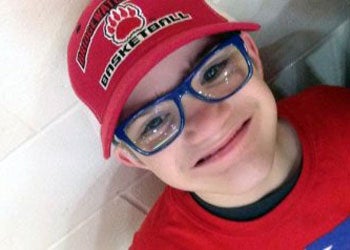
Alec Bruneau has found a new sense of confidence since coming to the Myhre Syndrome Clinic. Photo courtesy of April Lanord.