Multiple Specialists Join Forces to Care for Patient with Rare Connective Tissue Disorder
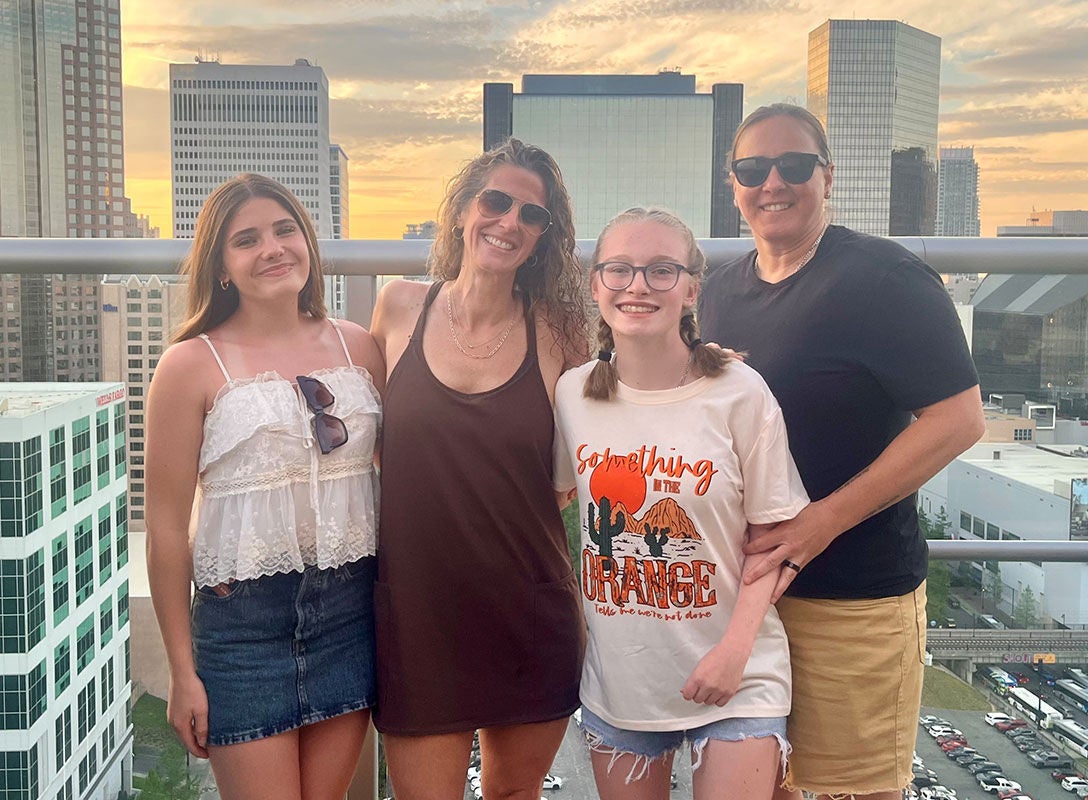
At age 41, Sharyl Carrigan felt far too young to be documenting her wishes in case she didn't survive the next few days. And yet here she was, lying in a hospital bed, writing her will on a piece of paper.
The previous week had been a whirlwind. First came the neck pain during a barre class at the gym. After the class ended, little squiggles (eye floaters) appeared, impairing her vision.
For many people, symptoms like these wouldn't be a major cause for concern. But Sharyl is a special case. She has a rare genetic mutation that makes her more prone to aortic dissection. Without prompt treatment, the condition can lead to sudden death.
When Sharyl woke up the next morning with a sore throat, she couldn't ignore her symptoms any longer. She rang the office of her Mass General Brigham primary care doctor, Christopher Trancynger, MD. He told her to get to an emergency room (ER) right away.
"Having all my care at Mass General Brigham saved my life," said Sharyl, who lives with her partner, Megan, and their two teenage girls in Mansfield, Massachusetts. "Based on my history, he knew how at risk I was. If he hadn't sent me to the ER, I wouldn't be here today."
A genetic mystery
Three decades ago, Sharyl's mother and three of her siblings died due to aortic aneurysms within several years of each other.
Doctors suspected genetics played a role in the deaths. During this period, Sharyl began going to a geneticist at Massachusetts General Hospital. The geneticist later moved on to another hospital but never forgot about her. Several years later, the geneticist read about the discovery of the ACTA2 mutation.
The ACTA2 gene provides instructions for making a protein that helps smooth muscle cells tighten and relax. Smooth muscle cells are found throughout the body, including in the walls of the aorta. Mutations in the ACTA2 gene prevent smooth muscles from forming properly, which weakens the aortic wall. This rare condition, a connective tissue disorder, increases the risk of aortic dissection.
Upon learning of the ACTA2 mutation, the geneticist called her successor at Mass General. She recommended that he test members of Sharyl's family for the mutation. All the tests came back positive. The mystery was finally solved.
'You need to lie down'
After testing positive for the mutation, Sharyl began seeing cardiologist Charles Boucher, MD, at the Mass General Brigham Heart and Vascular Institute. On Dr. Boucher's advice, she also took steps to avoid raising her blood pressure, from limiting her coffee intake to refraining from strenuous exercise.
For about 15 years, Sharyl's health was fine. Then came the distressing visit to the Mass General ER.
Minutes after her arrival, Sharyl had a CT scan. It showed an arterial dissection—specifically, a tear near the junction of the innominate and the right subclavian artery, which supply blood from the heart to the head, neck, and arms. Due to the tear, blood had pooled into a bulge protruding from the artery wall. The resulting pseudoaneurysm, also known as a "false aneurysm," can be fatal if it ruptures.
"I was sitting up when they told me," Sharyl recalled. "At that point, they said, 'You need to lie down.' It was that serious."
Vascular surgeon Nikolaos Zacharias, MD, MPH, was on hand to evaluate Sharyl. He quickly brought in his frequent collaborator on aortic surgeries, cardiac surgeon Arminder Jassar, MD, to discuss her case.
A patient with an aortic dissection usually has an operation to repair the tear immediately. But the ACTA2 mutation complicated matters.
"We took the time to gather all the diagnostic information we needed and get input from her cardiologist (Dr. Boucher) and neurologist (Patricia Musolino, MD, PhD)," Dr. Jassar said. "She wasn't going to be able to leave the hospital until it was fixed."
Learn about aortic dissection
Read about aortic dissection
Keeping her emotions in check
Sharyl spent six restless days in the intensive care unit awaiting surgery. "It was so hard lying there, wondering if I would make it," she said. "But getting emotional would raise my blood pressure and heart rate. I had to stay positive because my survival depended on it."
During the operation, the surgical team undertook two extremely complex tasks:
- Rerouting the right subclavian and vertebral artery (which supplies blood to the brain and spine) to the right common carotid artery in the neck
- Navigating nerves and a tangle of arteries to access and excise the pseudoaneurysm, which was the source of the bleeding
Drs. Jassar and Zacharias took the long view with their surgical plan. One approach for repairing a tear in this location would involve making a large cut down the middle of the chest to access the heart (a sternotomy) and rerouting the torn artery directly to the aorta. However, this would have been problematic for Sharyl.
"As a young patient with connective tissue disease, she may need more operations in the future," Dr. Jassar said. "A sternotomy makes successive cardiac surgeries riskier and more complicated. By limiting ourselves to a smaller incision, we were able to eliminate those concerns while still addressing the current problem."
Given they were working so close to the pseudoaneurysm, the two surgeons knew it might rupture during the operation. When it eventually did, they were prepared. While Dr. Jassar controlled the bleeding, Dr. Zacharias worked feverishly to finish rerouting the two arteries. After that, Dr. Jassar removed the pseudoaneurysm and tied off the torn artery. The procedure lasted about three hours.
Getting back on her feet
In recovery, Sharyl quickly bonded with the nurses on her floor.
They were absolutely amazing. I remember crying every day and just being so grateful for how kind and supportive they were. Everyone was so invested in my care.
Sharyl Carrigan
- Patient treated for aortic dissection
Over the next few days, Sharyl hosted a parade of visitors, from Megan and the girls to Dr. Zacharias, Dr. Jassar, and several other doctors on her extended care team. "Pretty much everyone except my gynecologist stopped by," she quipped.
A week and a half after Sharyl arrived at Mass General, her doctors deemed her ready to go home. There, a home health nurse visited regularly to monitor her blood pressure, wound healing, and overall health.
Recovery, as expected, was a slow process. For the first couple weeks, she needed help showering and getting dressed. Soon she started walking outside. At first, she could barely make it two houses down the road.
"I decided that each day, I was going to add one house," she said. "The next day, I got to three houses. The day after that, it was four houses. I knew being active is what my body needed."
Getting clearance to return to running was a huge milestone for Sharyl. "I remember finishing my run and sobbing, realizing how lucky I was to be alive and finding my way to a new normal," she said.
Mutation hits a dead end
Sharyl, now three-and-a-half years out from her surgery, recently received good news: Genetic testing showed her biological daughter doesn't have the ACTA2 mutation. (Her other daughter is adopted.) Because her cousin's sole child is adopted and her aunt didn't have children, the mutation will no longer be passed down in the family.
Currently, Sharyl sees several of her doctors on an annual basis. Since the ACTA2 mutation can impact her vision, one of these doctors is a well-known authority on ACTA2 — neuro-ophthalmologist Joseph Rizzo, MD, of Mass Eye and Ear, a member of Mass General Brigham.
Dr. Zacharias, who sees Sharyl each year, is pleased with how far she has come. "Today, she's doing remarkably well," he said. "Her subclavian pseudoaneurysm has been successfully treated, and imaging scans show her arteries look very healthy. Combined with her commitment to a healthy diet and regular exercise, she's in excellent overall health. As her care team, we're very happy to see that she's feeling well and continuing to thrive."
Sharyl credits her Mass General Brigham care team for not only saving her life but also allowing her to enjoy such a good quality of life.
"What can you say to the people who took care of you in your most fragile state? A simple 'thank-you' isn't enough." she said. "I couldn't have asked for better doctors, better nurses, or better care."
Learn about our Thoracic Aortic Program
Explore our program and care team