false

Functional Neurosurgery Program
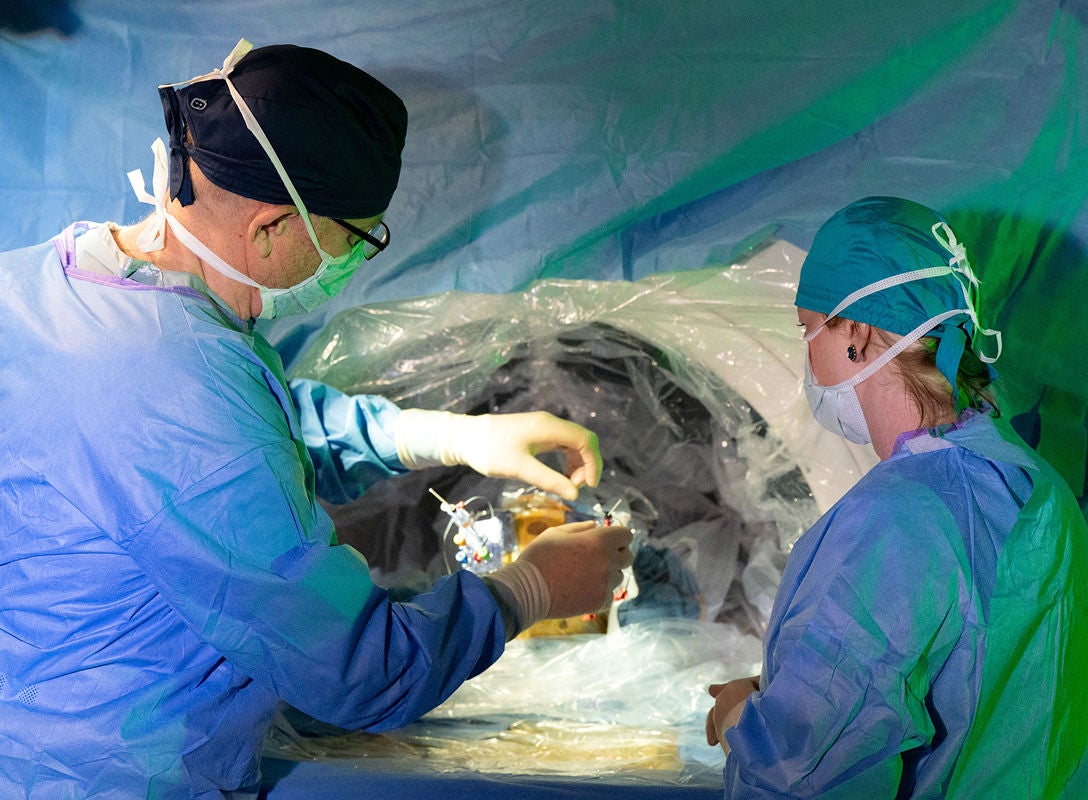
Mass General Brigham Neuroscience Institute treats patients with movement disorders, epilepsy, psychiatric conditions, and other neurological conditions. We focus on relieving your symptoms while reducing side effects so that you move and feel your best.

Two surgeons in full surgical attire work together in a brightly lit operating room.

full-fill

Advanced surgical solutions and collaborative neuroscience care

When medications are not enough to manage your symptoms, our team offers advanced surgical options such as deep brain stimulation and responsive neurostimulation, paired with comprehensive evaluation and follow-up care. We work closely with you to determine the best approach for your needs.

As part of the Mass General Brigham Neuroscience Institute, we bring together leading clinicians and researchers to advance neurosurgical care for movement disorders, epilepsy, and related conditions.

center
tertiary
internal-arrow
Part of the Neuroscience Institute
/content/unified-xwalk/en/services/neuroscience

Our approach to care

We use a coordinated, multidisciplinary approach to recommend the most effective treatment options for your condition.
Your personalized care plan

Every treatment plan is focused on your personal symptoms, goals, and health needs. Our team meets regularly to discuss each case, and recommend the least invasive, most effective surgical options.

Each patient’s treatment is managed by a team of specialists that includes:

  • Neurosurgeons
  • Neurologists
  • Neuroradiologists
  • Neuropsychologists
  • Nurse practitioners
Surgical treatment for epilepsy
For 20–30% of people with epilepsy, surgery may be required to address seizures. We perform a thorough evaluation to determine whether seizures can be treated by removing or disconnecting the area where they begin, or through neuromodulation therapies such as DBS, VNS, or RNS.
Surgical treatment for movement disorders

DBS can also treat disorders like Parkinson’s disease, dystonia, and essential tremors. It works by regulating abnormal nerve activity in targeted areas of the brain.

Mass General Brigham Neuroscience Institute doctors were among the first to perform DBS. Today, we use it to treat many different types of dystonia, including:

  • Genetic dystonia
  • Generalized dystonia
  • Hemidystonia
  • Segmental dystonia
  • Focal dystonia
Surgical treatment for psychiatric conditions
For some people with severe and treatment-resistant psychiatric conditions, surgery may be an option. Our specialists offer procedures such as cingulotomy, subcaudate tractotomy, VNS, and, in select cases, DBS through research protocols. These treatments are considered only after a comprehensive evaluation with our multidisciplinary team.
Relief for chronic pain and tics

Tics and facial pain often occur when a blood vessel presses on a nerve. If medication is not effective, our surgeons use a variety of techniques to provide relief, such as:

  • Microvascular decompression to relieve pressure on the nerve
  • Stereotactic radiofrequency thermal lesioning—a minimally invasive technique developed at Mass General—to numb the nerve
  • Botox to control muscle spasms
Highly specialized, high-volume care
Mass General Brigham Neuroscience Institute is home to one of the largest functional neurosurgery centers in the United States. We treat dozens of patients a day, and perform over 2,500 surgeries a year. This depth of experiences means our clinicians are highly skilled in managing complex and rare cases, allowing us to provide focused care for any patient.
We tailor each treatment to your needs, using proven therapies and leading-edge techniques to help you move and feel your best.

Neuroscience clinical trials and research

Our research is shaping the future of neuroscience care. We offer access to clinical trials and emerging therapies, including treatments that may not yet be widely available. Eligibility depends on a person’s diagnosis, treatment history, and more. Explore our research and clinical trials or talk with your care team to learn about available options.
A scientist in a white lab coat holds a rack of test tubes filled with yellow liquid.
tertiary
external
Explore our neuroscience research

Learn how neuroscience research informs patient care

https://research.massgeneralbrigham.org/en/institutes-centers/neuroscience-institute
tertiary
external
Search clinical trials

Search open clinical trials for neurological conditions

https://rally.massgeneralbrigham.org/