
Skip to cookie consent Skip to main content

Emergency Department Intervention Boosts Advance Care Planning and Goal-Aligned, End-of-Life Care

4 minute read

Kei Ouchi, MD, MPH, of the Mass General Brigham Department of Emergency Medicine, is co senior author and Angelo E. Volandes, MD, MPH, of the Department of Medicine, is the lead author of a paper published in the Journal of General Internal Medicine, “Effect of Emergency Department Initiated Video Enhanced Advance Care Planning on Documentation and Goal Concordant Care: A Randomized Clinical Trial.

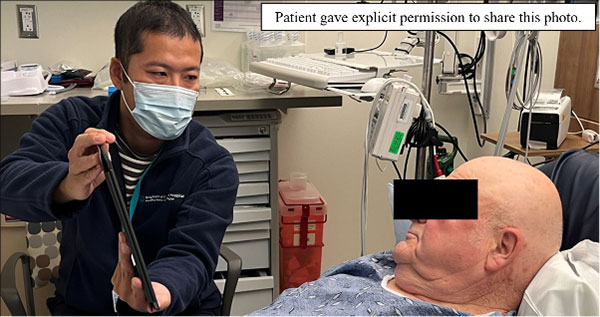
A physician holds up a table to display a video to patient lying in a hospital bed. Text on the image reads: Patient gave explicit permission to share this photo.
Kei Ouchi, MD, MPH (left) shows a video to a participant enrolled in the study.

Q: What challenges or unmet needs make this study important?

Conversations between clinicians and patients with serious, life-limiting illnesses to discuss their values, goals and priorities at the end of life—also known as advance care planning, or ACP—are widely encouraged because such conversations are associated with improved quality of life and reduced healthcare expenditures. Yet, most seriously ill older patients do not get the opportunity for ACP before death, which often results in unnecessary or undesired care. 

Furthermore, there is long standing concern that ACP and documentation may not reliably translate into care that reflects patients’ stated goals, especially near the end of life. Prior randomized trials have shown only modest improvements in documentation and little evidence of improved goal concordant care. This gap is particularly acute in emergency departments (EDs), where millions of seriously ill older adults seek care each year near the end of life, often without documented preferences to guide critical decisions. The ED represents both a high risk setting for unwanted aggressive care and an underutilized opportunity to initiate meaningful ACP. 

Q: What central question(s) were you investigating?

We tested whether an intervention we developed that combines a video decision aid with a structured conversation about ACP could help increase ACP documentation among older adults. Specifically, we wanted to test whether this intervention could be initiated in the ED, and if this would lead to an increase in ACP documentation in the electronic health record (EHR), indicating more ACP conversations. We also asked whether the intervention could help align end-of-life care with what patients would have wanted compared with usual care. 

Q: What methods or approach did you use?

We conducted a multicenter, parallel group randomized clinical trial from 2022–2024 in three emergency departments. Nearly 600 adults aged 65 or older, or between the ages of 50–64 with serious illness, were randomized.

Patients in the intervention group:

  • Watched a 5 minute, evidence based ACP video,
  • Participated in a structured ACP conversation with a trained clinician, and
  • Had a summary of the conversation communicated to treating clinicians and primary care providers through the EHR.

Patients in the control group received usual ED care. 

Q: What did you find? 

ACP documentation was significantly higher in the intervention group compared to the control group at both three months (approximately 46% vs. 31%) and six months (approximately 52% vs. 39%).

Patients who received the intervention also demonstrated greater ACP knowledge and engagement. Importantly, among the 94 participants who died during follow up, those in the intervention group had substantially higher goal concordance scores, indicating care more closely aligned with their documented wishes. 

Q: Were you surprised by any of the findings?

One of the most striking findings was the magnitude of improvement in goal concordant care among decedents. Despite longstanding skepticism about whether ACP alters real-world care, the intervention group achieved a meaningful improvement on a rigorous, clinician-rated concordance scale—suggesting that even brief, well-designed ACP interventions can have lasting effects.

Q: What are the real-world implications, particularly for patients? 

This study provides rare, randomized evidence that ACP can meaningfully influence real clinical decisions, not just paperwork. Initiating ACP in the ED using brief video education and structured conversations can help ensure that seriously ill older adults receive care that better aligns with their values—especially near the end of life. The findings suggest that ED based ACP is both feasible and impactful, and that EDs can play a critical role in improving patient centered care across health systems. 

Authorship: In addition to Volandes and Ouchi, authors include Hacho Bohossian, Yuchiao Chang, Charlotta Lindvall, Michael K. Paasche-Orlow, Seth Randa, Upeka Samarakoon, Tadayuki Hashimoto, Nanako Shirai, Aretha D. Davis, Nathan E. Goldstein, Cynthia Garde, Gabriel A. Paasche-Orlow, Kate Sciacca, Karina Klein, Eric Hanson, Allyson Sage, Donovan S. Nielsen, Beth Walker-Corkery, Areej El-Jawahri, Michael J. Barry, Milton Joel, Timothy Platts-Mills, Brigitte N. Durieux, Anne Kwok, and Katren R. Tyler.

Paper cited: Volandes, AE., et al. “Effect of Emergency Department Initiated Video Enhanced Advance Care Planning on Documentation and Goal Concordant Care: A Randomized Clinical Trial.” Journal of General Internal Medicine. DOI: 10.1007/s11606 026 10406 6
Funding: This study was supported by the National Institute on Aging (NIH) (R01AG065254).

Disclosures: Volandes and Davis report leadership roles with ACP Decisions, a nonprofit organization supporting shared decision making through video decision aids. Other authors reported no competing interests.

Kei Ouchi, MD, MPH headshot

Co-senior author

Media contact

Mike Morrison
Senior Director, External Communications, Hospitals

About Mass General Brigham

Mass General Brigham is an integrated academic health care system, uniting great minds to solve the hardest problems in medicine for our communities and the world. Mass General Brigham connects a full continuum of care across a system of academic medical centers, community and specialty hospitals, a health insurance plan, physician networks, community health centers, home care, and long-term care services. Mass General Brigham is a nonprofit organization committed to patient care, research, teaching, and service to the community. In addition, Mass General Brigham is one of the nation’s leading biomedical research organizations with several Harvard Medical School teaching hospitals. For more information, please visit massgeneralbrigham.org.