Helping Families Begin with Care, Dignity and Support in the Communities We Serve
Note: This article contains a reference to domestic abuse.
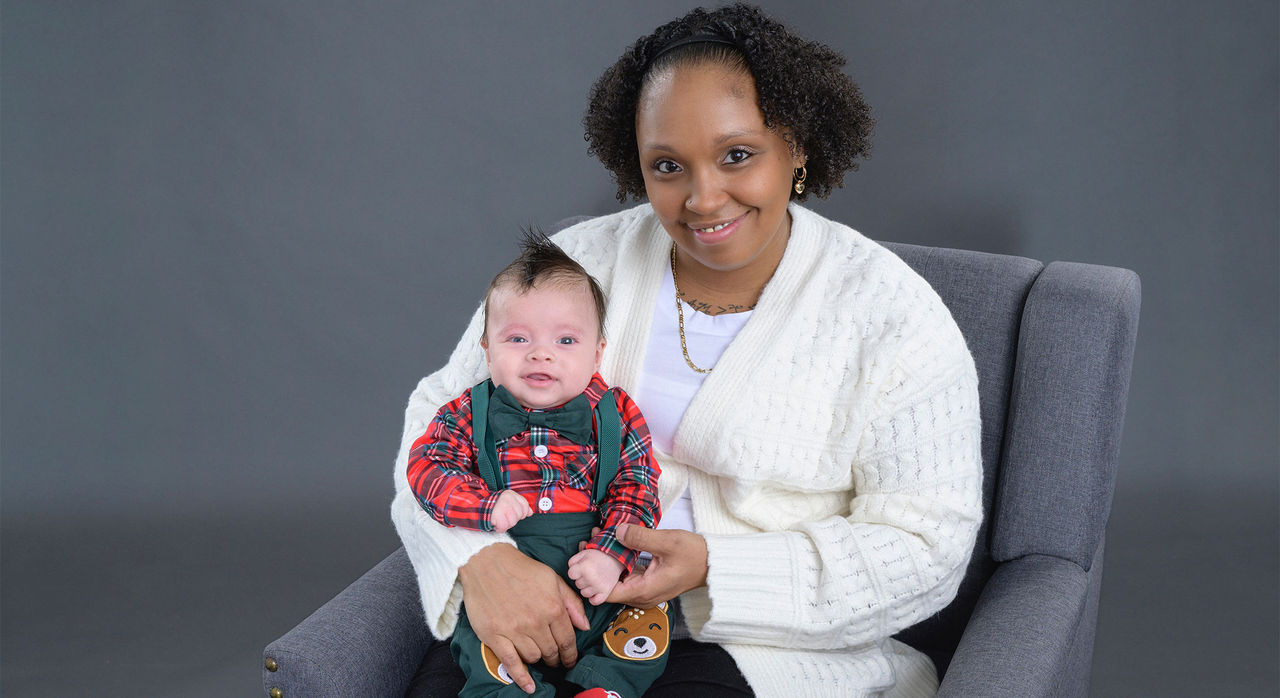
When Alea Martinez, 37, looks at her infant son, her heart swells with love, gratitude and hope.
“I will be his first love, and he will be my last love,” she said. “After all I’ve been through, raising my son by myself is the biggest blessing I could ever pray for. He is my motivation to achieve my goals and dreams, not only for myself but for him too. I want to show and teach him that no matter what obstacles you deal with, you can always achieve your goals and dreams.”
In a sense, she has already accomplished one of those goals: becoming a mother, something she has dreamed of for as long as she can remember. The oldest of six siblings, Alea never tired of helping care for her younger brothers and sisters while they were growing up. Even as adults, they still come to her.
Her son, Sincere, is now 7 months old — a happy baby on the move around her South Boston apartment.
“He’s crawling now, so I had to buy him a floor playpen,” she said with a laugh.
Motherhood isn’t her only dream realized. She has found peace, safety and stability over the past 18 months. In that time, she left an abusive marriage, discovered she was pregnant, recommitted to caring for her mental health and obtained her own apartment after living in a shelter for most of her pregnancy and the early postpartum days.
Alea has new dreams, too. She’s pursuing a workforce training program in healthcare. Eventually, she wants to go to nursing school and become a pediatric nurse.
She cannot imagine being where she is today without the support of Mass General Brigham’s Family Partnership Program, which provides intensive, one-on-one support to vulnerable patients during their pregnancy all the way through the child’s first birthday.
“I don’t know how I would’ve gotten through my pregnancy or after without Family Partners, specifically my family partner, Joyce. I asked her, ‘Can you stay with me forever?’” Alea said. “When I didn’t have enough to eat, she got me food deliveries. When the government cut food stamps, she gave me gift cards to Stop & Shop. When I was very pregnant and could barely walk, she signed me up for PT-1 rides to get to and from appointments.”
The program is part of a larger Mass General Brigham initiative to improve health outcomes for mothers and infants in the communities we serve. It focuses on addressing high-risk clinical conditions, such as hypertension and mental health conditions, as well as social determinants of health (SDoH), a term for nonmedical factors that influence a person’s health, such as housing, food security, employment and transportation.
“One thing that really stands out about this program is that it spans a critical continuum of time for our birthing patients. We’re connecting with patients in early pregnancy, supporting them through birth and continuing to engage with them during that first year postpartum,” said Amaka Onwuzurike, MD, associate medical director for Maternal and Infant Health Equity at Mass General Brigham. “At each of these points, there are unique risks for complications and adverse outcomes that can impact short- and long-term health. The length of the program gives us the opportunity to identify risk factors early, intervene with support to address health and social risk, and improve outcomes for our patients and their families.”
Support, resources and empowerment
The Family Partnership Program serves patients who have (or are at higher risk of developing) a medically complex pregnancy, have at least one identified SDoH need and who plan to deliver at Brigham and Women’s Hospital, Massachusetts General Hospital, Newton-Wellesley Hospital or Salem Hospital. Patients do not need to receive their primary or prenatal care through Mass General Brigham, but they must be enrolled before 34 weeks of pregnancy to qualify.
Patients in the program are paired with a community health worker, or “Family Partner,” who serves as their personal navigator, advocate and educator — helping patients access prenatal, postpartum and primary care, connecting them to various resources, providing coaching towards goals and basic health education, and much more. Family Partners document their care in the patient’s electronic medical record, ensuring other members of their care team are informed about their status and progress.
The program as it exists today launched in May 2025, having expanded from a prior initiative by the same name at Brigham and Women’s into a systemwide effort. Today, over 160 patients are enrolled in the Family Partnership Program and more than 50 have delivered their babies. To address the growing needs of the community, the program will be able to expand to support 500 to 600 patients.
In addition to a structured schedule of coaching sessions with patients, Family Partners are often a lifeline as urgent needs arise, explained Madison Louis, MPH, senior program manager for Maternal-Infant Programs.
“For many Family Partners, they might be on the phone every day with their patient throughout the week to work through a crisis,” Louis said. “To give you an example, one pregnant patient came to the program with gestational diabetes, high blood pressure and mental health concerns. Her Family Partner provided her with a blood pressure cuff and glucose monitor, taught her how to check her blood pressure and blood sugars, and gave her a notebook to record those. Her Family Partner also connected her to a primary care provider, a pediatrician and our Mobile Postpartum Care Unit, where she was able to access both physical and mental health care.”
Giselle Sabido, a Family Partner at Salem Hospital, said the trusting relationships she builds with patients are the bedrock of making these kinds of strides.
“Patients have shared that they feel at ease in connecting with a provider they can communicate with comfortably in their native language and can understand their culture,” she said. “I have noticed patients begin developing trust throughout our coaching sessions and allowing support in more sensitive crisis matters that may not have been disclosed had they not developed that trust with a provider. It is becoming more evident to me as I continue to receive patient referrals and meet with patients that there is a profound impact in having a provider that supports both maternal and child health outcomes across the life course.”