When 12-year-old Remy Dumas began experiencing persistent hip pain, his parents, Doug and Melinda, assumed it might be a sports injury or growing pains. Remy, an energetic and active pre-teen, had always been healthy, making the sudden discomfort all the more concerning.
It wasn’t obvious from the outside — the tumor never protruded past his skin — but his father noticed subtle changes: Remy was losing weight, becoming fatigued and didn’t seem like himself.
Concerned about sudden changes in Remy’s health, his father pushed for further testing. Imaging confirmed the diagnosis: Ewing sarcoma, a rare bone cancer that primarily affects children and adolescents.
The disease begins in the bones and can sometimes spread to other parts of the body, most commonly the lungs or bone marrow.
The diagnosis marked the start of an intense journey through chemotherapy and radiation — one that would ultimately place Remy at the forefront of a new chapter in cancer care.
Beginning treatment
Following an initial course of chemotherapy, Remy responded exceptionally well. The treatment shrank the tumor and cleared most of the small spots in his lungs.
To address the remaining tumor in his pelvis, the family met with Hesham Elhalawani, MD, MSc, of the Mass General Brigham Cancer Institute. Dr. Elhalawani specifically serves as the director of Pediatric and Young Adult Radiation Oncology at Brigham and Women’s Hospital.
Dr. Elhalawani introduced adaptive radiation treatment (ART), a novel approach not yet widely used in children with cancer and an alternative to a complex surgery that could have required removing part of his pelvic bone and years of rehabilitation.
Exploring adaptive radiation treatment
After much deliberation and research, Doug and Melinda decided to give Remy the best chance with the ART.
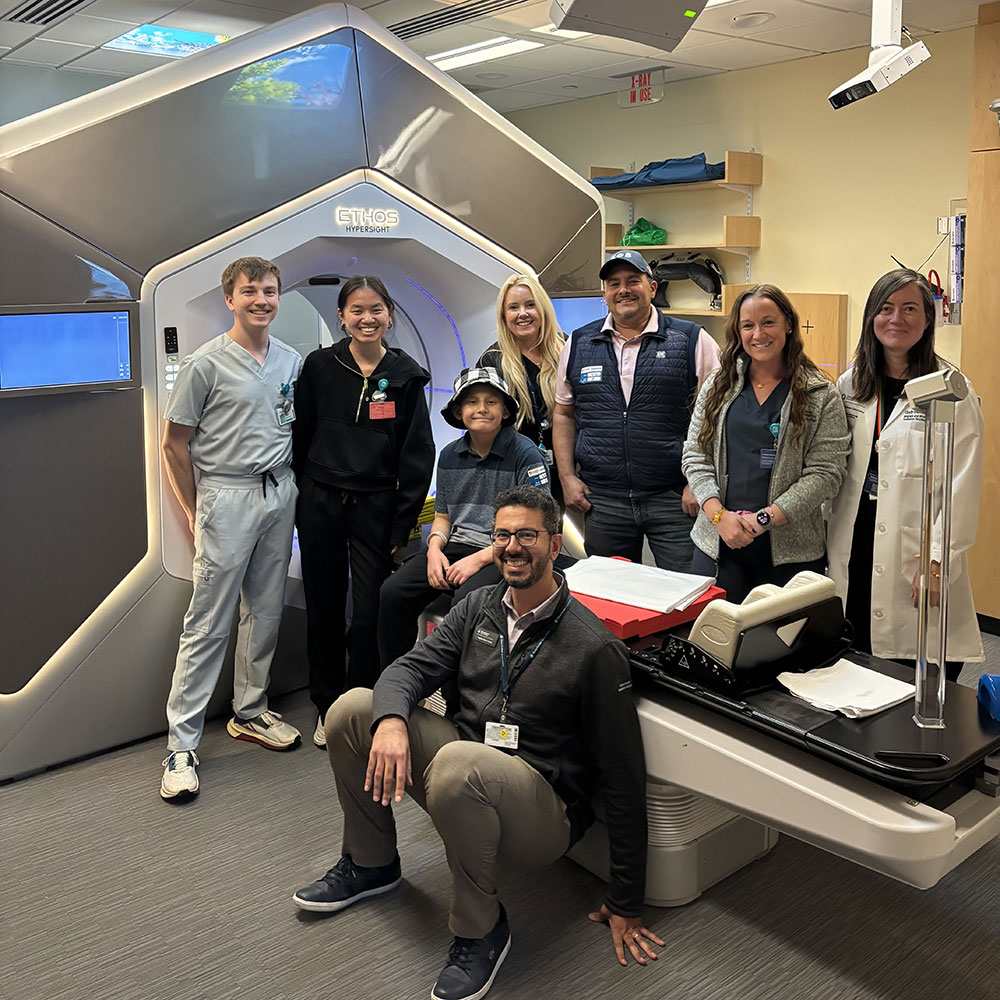
He made history as the first pediatric patient at Brigham and Women’s Hospital ever to receive ART using the Ethos system — a technology that personalizes treatment in real-time.
“Traditionally, once a radiation plan is created at the start of therapy, the same plan is used every day,” said Dr. Elhalawani. “But children’s bodies can change quickly during treatment—tumors can shrink, organs can move, and a child’s anatomy can shift as their bladder or bowels fill differently each day. All these changes can affect how accurately radiation hits the tumor or spares developing internal organs, which could inadvertently impact their function in the long term.”
Remy’s parents recall being initially surprised when told that their son would be the first child in Massachusetts to undergo this type of treatment.
“It was overwhelming at first,” said Doug. “But when Dr. Elhalawani and the team explained how it worked and how carefully they would monitor everything, we felt confident it was the right choice.”