
Committed Care Team Explores Every Avenue Possible to Treat Young Woman's Multiple Myeloma
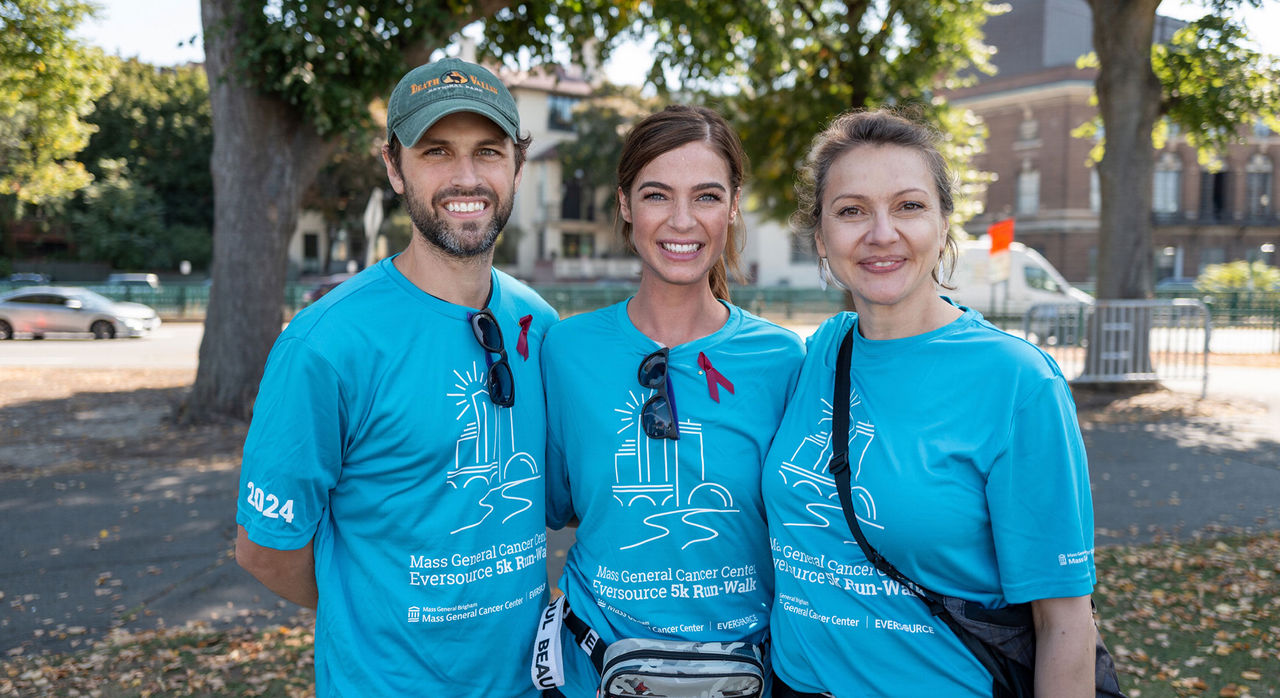
Tess (center) with her husband and Mass General Brigham oncologist, Diana Cirstea, MD at the annual Mass General Brigham Eversource Cancer 5k Run-Walk.
Tess Lopes considers her life to have a clear "before" and "after." The event separating the two was being diagnosed with, a rare blood cancer that affects the bone marrow. She was just 35 years old.
When she first felt cold-like symptoms, Tess didn't give it much thought. As a special education paraprofessional at an elementary school, she figured she must have caught something from one of her students. But then her lower back began to ache, and she developed flu-like symptoms.
Soon she found herself weak, exhausted, and unable to get out of bed. She tested negative for the flu and COVID-19 before her husband, Jeff, took her to an urgent care clinic. In reviewing the results of a blood test, a doctor said something was wrong. He wasn't sure what it was, but she needed to get to an emergency room right away.
Tess was taken via ambulance to a local hospital. As she was being discharged five days later, an oncologist there told her she had myeloma. She refused to believe it.
"I was young, healthy, and busy. I was helping children learn and planning to start a family," she said. "I never imagined I'd be fighting to stay alive at 35."
From multiple myeloma to plasma cell leukemia
A few days later, Tess saw her primary care doctor at Massachusetts General Hospital. Her next appointment was with medical oncologist Diana Cirstea, MD, at Mass General Brigham Cancer Institute.
Dr. Cirstea had reviewed Tess' blood tests along with a CT scan that had been taken at the urgent care clinic revealing widespread bone lesions and a fractured rib. She was concerned. One, myeloma was flooding Tess' bone marrow, producing an overwhelming number of abnormal antibody fragments that threatened her organs. Two, it was exceptionally rare for someone as young as Tess to have myeloma. Both are signs of an aggressive form of the disease.
"But given her age and knowing that myeloma today responds to upfront treatment very well, I had a lot of confidence and hope that she would do well," Dr. Cirstea said.
A prospective treatment plan would need to factor in that Tess and Jeff were planning to start a family. Dr. Cirstea brought in Mitchell Rein, MD, a reproductive endocrinology and infertility specialist at Mass General Brigham.
The two doctors agreed to delay the drugs usually taken for myeloma treatment and begin on drugs that would not damage her reproductive health. That allowed Tess to first undergo egg retrieval for in vitro fertilization while presumably keeping the cancer at bay.
The fertility procedure was a success. In the interim, though, something unforeseen had happened: The myeloma had spread at an alarming rate. Then, it had quickly advanced to plasma cell leukemia (PCL). With this rare, aggressive form of myeloma, the abnormal plasma cells that remain inside the bone in typical myeloma patients escape and make their way into the bloodstream. In Tess' case, these cancer cells were found circulating in very high numbers.
"Every time a door closed, Dr. Cirstea and my care team found another one to open," Tess said. "They never gave up. No matter what happened, they always had another plan."
"When I saw the transformation to PCL and the extremely high count of leukemic plasma cells in the blood, it was chilling," Dr. Cirstea said. "It was an unusually aggressive transformation that took place within a week, something I'd never seen before. At that point, I was very worried about Tess' outlook."
Tumor lysis syndrome leads to kidney failure
Young, healthy, and with her egg retrieval complete, Tess quickly ramped up to the full, four-drug frontline treatment regimen. Due to the aggressive nature of her myeloma, she took this regimen at the highest possible doses.
The first treatment began to work within just a few days. It worked so well, in fact, that it killed cancer cells faster than Tess' body was able to clean out the debris. This led her to develop a condition known as tumor lysis syndrome.
Tumor lysis syndrome is an emergency that can come on within hours and cause a host of dangerous problems, including the failure of the kidneys, heart, liver, and other organs. In Tess' case, the shed debris clogged her kidneys, which were already overtaxed from processing byproducts of her cancer as well as chemicals from her treatment. As a result, she experienced massive electrolyte imbalances and kidney failure.
Due to the tumor lysis syndrome, Tess woke up one morning unable to walk or even stand on her own. Jeff immediately took her back to Mass General's emergency room. Dr. Cirstea and nephrologist (kidney specialist) Danielle Saly, MD, MPH, rushed to see her.
"At Mass General Brigham, our doctors work together to an amazing degree. It's a deeply collaborative team, built on trust and constant communication." Dr. Cirstea said. "We started Tess on dialysis right there in the emergency department."
Tess spent another three days in the Medical Intensive Care Unit followed by three weeks as an inpatient at Mass General. After she recovered enough to go home, she continued her 12+ weekly hours of dialysis on an outpatient basis.
Shifting to a new solution: bispecific antibodies
Upon transforming into PCL, Tess' ultra-aggressive myeloma gained the ability to travel anywhere in her body. In the wake of her tumor lysis syndrome, Dr. Cirstea had to find a combination of drugs and dosages that was strong enough to abate the myeloma, wouldn't be removed by dialysis, and wouldn't build up enough to poison her.
Over the next six weeks, three more lines of treatments showed early promise but ultimately failed when Tess' highly adaptive cancer built resistance to each treatment and came back stronger than before. The experience took its toll on her.
"My whole body hurt. I remember googling, 'How much pain can you be in before you die?,'" she said. "I just had to put my complete trust in my doctors. Even though Jeff and I were scared, we had total confidence in Dr. Cirstea because we could feel how deeply she cared."
In evaluating options for the fifth line of treatment, Dr. Cirstea turned to a different strategy: bispecific antibodies. These are a newer type of immunotherapy that direct a person's own T-cells (immune cells) to kill myeloma cells.
"At Mass General Brigham, we have access to novel immunotherapies and other cutting-edge drugs that often aren't available elsewhere," Dr. Cirstea said. "Equally important, we have the skills and the infrastructure support to administer these drugs safely."
The first bispecific worked for a little while but lost its effect after a few weeks. So, Dr. Cirstea switched Tess to talquetamab, a different bispecific. Talquetamab had a dramatic impact, virtually eliminating all signs of cancer activity within weeks. At last, a turning point had come.
"Every time a door closed, Dr. Cirstea and my care team found another one to open," Tess said. "They never gave up. No matter what happened, they always had another plan."
CAR T-cell therapy leads to remission
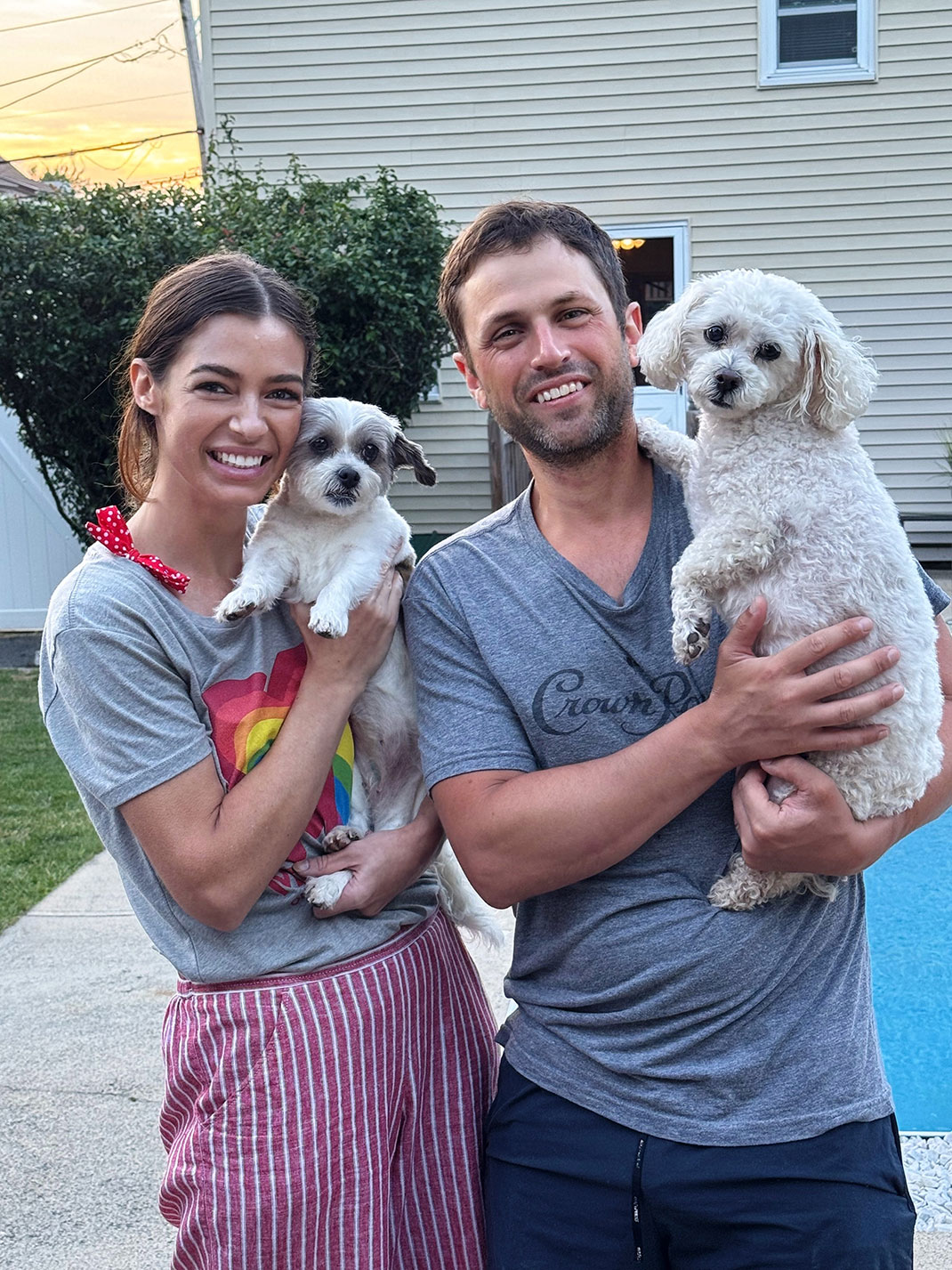
'There is a future waiting for you'
Tess still faces an uncertain outlook in many ways. Because her kidneys and bone marrow are both affected, the best long-term option would be a coordinated kidney and bone marrow transplant, ideally from the same donor, performed in tandem. Finding someone who could safely provide both, however, is extraordinarily rare. Pregnancy, meanwhile, would bring its own medical risks.
For now, Tess is focused on her continued recovery. "I'm still healing, still rebuilding, and still learning how to live in a body and life I don't recognize," she said. "Cancer changed every plan I had, but it also forced me to discover strengths I didn't know were in me. It's a long road, but I am looking forward to building a future that still belongs to me while treasuring every moment I once feared I'd lose."
At her monthly appointments at Mass General Brigham Cancer Institute in Danvers, Tess undergoes testing to watch for signs of myeloma and monitor her kidney function. At each visit, she also receives an infusion of donated immune system antibodies to help her body ward off infections.
Reflecting on the past two years, Tess expressed gratitude for her entire care team—especially Dr. Cirstea. "She gave me back the possibilities that I feared would be gone forever," Tess said. "She's someone who will be important to my family and me for the rest of our lives. She's truly incredible."
Tess also had a heartfelt message for anyone who is on their own cancer journey.
"Losing your old life is heartbreaking, but it doesn't mean you won't build a new one worth living," she said. "You may not recognize yourself on some days, but that doesn't mean you're gone; it means you're becoming someone who has survived something unimaginable. Your life isn't over. Even if it feels unrecognizable, there is a future waiting for you."