
Skip to cookie consent Skip to main content

Study Illuminates How an Antiviral Defense Mechanism May Lead to Alzheimer’s Disease

3 minute read

Mass General Brigham researchers found that hyperphosphorylated tau, the main component of pathological tangles in Alzheimer’s disease, may help protect the brain from infection.
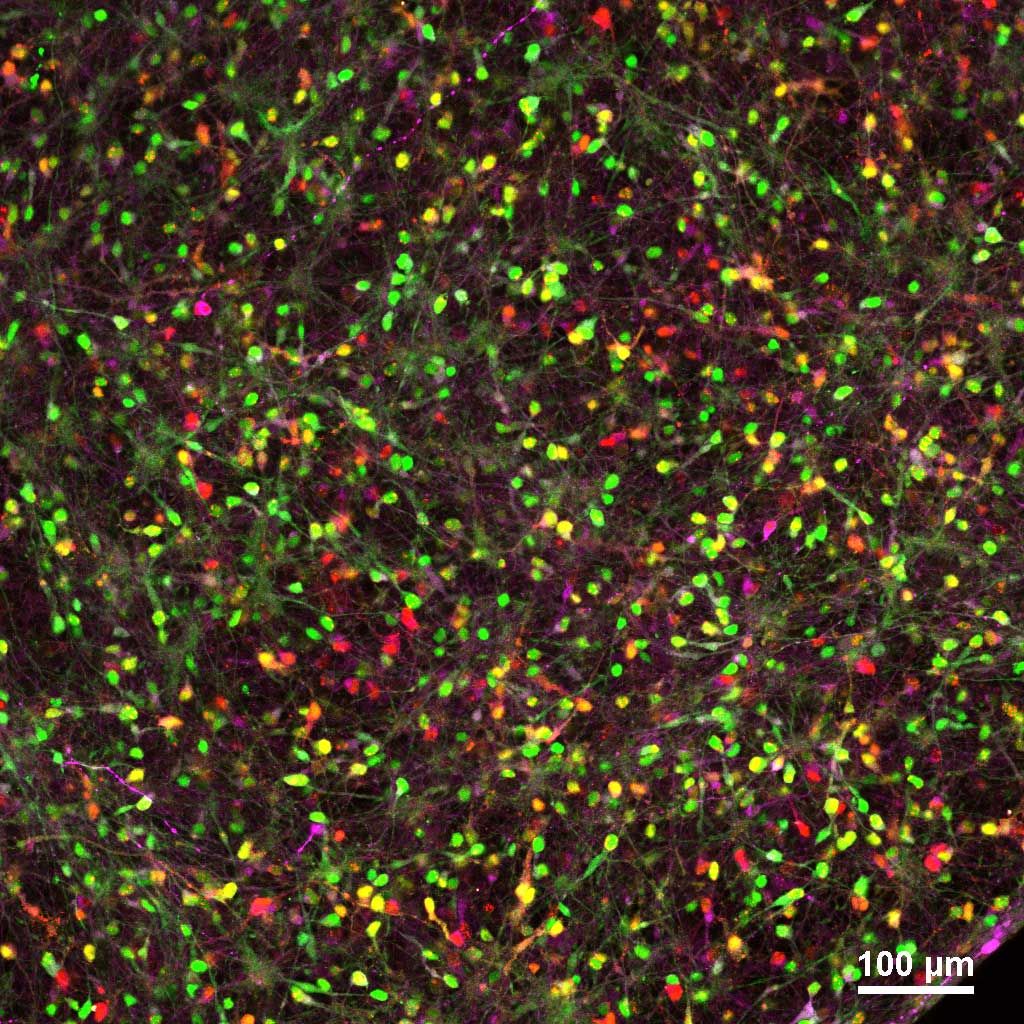

A tangle of green, yellow, and red neurons joined by thin lines, with occasional crackles of bright purple.
A 3D human neuronal culture system (ReNcell VM - green) was infected with HSV-1 (red) and co-stained with a phosphorylated tau antibody to identify cellular p-tau levels and distribution (purple) changes as a result of the infection.

One of the main proteins that contributes to Alzheimer’s disease is called phospho-tau (p-tau). When p-tau gets too many phosphate groups attached to it (a process called hyperphosphorylation), it starts to stick together and form clumps called “tangles” inside of brain nerve cells. A new study from Mass General Brigham investigators shows that tau hyperphosphorylation may be a consequence of an antiviral response that protects the brain from infection. Results are published in Nature Neuroscience.

“As a geneticist, I always wondered why humans had evolved gene mutations predisposing to Alzheimer’s disease,” said senior author Rudolph Tanzi, PhD, Director of the McCance Center for Brain Health and Genetics and Aging Research Unit in the Mass General Brigham Department of Neurology. “Our work indicates that many of the features of Alzheimer’s disease that we think of as only pathological from may once have been protective.”

Tanzi believes that people who had genes that predisposed them Alzheimer’s pathology from amyloid, to tangles to neuroinflammation may have had a survival advantage against widespread infection back when human lifespan was 30 years or less. But as lifespan has lengthened, these same mutations increase susceptibility to Alzheimer’s disease. 

“Together with our earlier work showing amyloid beta, the main component of senile plaques, is an antimicrobial protein, we believe Alzheimer’s pathology may have evolved as an orchestrated host defense system for the brain,” said Tanzi.

Using a human-derived neuron cell culture model with an affinity for phosphorylated tau, the researchers exposed the cells to the HSV1 virus with the goal of investigating the interaction between tau, the virus, and neurons. They found that the HSV1 infection caused hyperphosphorylation in tau, which then formed aggregates, producing a pathology similar to that seen in Alzheimer’s disease. They also found that tau is able to bind to the capsid of the virus, neutralizing infection. This serves as a protective factor to the neurons, by preventing and trapping the virus from attacking the cells.

In a feedback mechanism, neurons infected with HSV-1 released hyperphosphorylated tau as they formed tangles, and the hyperphosphorylated tau then bound to the virus, blocking it from further attacking the neurons.

“Our findings reveal an important novel role for tau as an antiviral protein against HSV1 and probably other viruses,” said lead author William Eimer, PhD, of the Mass General Brigham Department of Neurology. “Tangles may have originally formed in response to both amyloid and viral infection to prevent the spread of the virus from neuron to neuron in the brain.”

Authorship: In addition to Eimer and Tanzi, Mass General Brigham authors include Alex S. Rodriguez, Michael T. DeFao, Joseph Park, Deepak K. Vijaya Kumar, Nanda K. Navalpur Shanmugam, and Robert D. Moir. Additional authors include Simon Ehricke, Sanjana Singh, and Tara Sawhney.

Funding: Support provided by the National Institute of Aging (RF1AG061035-01) and the Cure Alzheimer’s Fund. The funders had no role in study design, data collection and analysis, decision to publish or preparation of the manuscript.

Paper cited: Eimer WA et al. “Phosphorylated Tau Exhibits Antimicrobial Activity Capable of Neutralizing Herpes Simplex Virus 1 Infectivity in Human Neurons” Nature Neuroscience DOI: 10.1038/s41593-025-02157-0

Media contact

Brandon Chase
Senior Specialist, External Communications

About Mass General Brigham

Mass General Brigham is an integrated academic health care system, uniting great minds to solve the hardest problems in medicine for our communities and the world. Mass General Brigham connects a full continuum of care across a system of academic medical centers, community and specialty hospitals, a health insurance plan, physician networks, community health centers, home care, and long-term care services. Mass General Brigham is a nonprofit organization committed to patient care, research, teaching, and service to the community. In addition, Mass General Brigham is one of the nation’s leading biomedical research organizations with several Harvard Medical School teaching hospitals. For more information, please visit massgeneralbrigham.org.