
Dear applicants,
We are thrilled to welcome you to Mass General Brigham Neurosurgery for interviews for the Mass General Brigham Neurosurgery Residency Program. Last year, Mass General Hospital and Brigham and Women’s Hospital Departments of Neurosurgery merged to become Mass General Brigham Neurosurgery. Over the last couple months, the creation of a new integrated Mass General Brigham Neurosurgical Residency training program was approved by the ACGME.
Transformation is and will be challenging, but the result will be the most influential, inclusive and patient focused academic department of Neurosurgery in the world, delivering the highest-quality trainee education as well as research-infused care to the patients and families it serves by working better together. By combining these two AMC departments and working collaboratively across our entire system, I’m confident that we can improve the clinician and patient experience and make significant progress toward creating more access for the many patients who need neurosurgical care.
I know that, together, we will strengthen our clinical, research and education programs. Our goal is to become One Mass General Brigham Neurosurgery. As one department, we will accomplish amazing things together to treat patients, develop new therapies, and train the next generation of leaders in our field of neurosurgery.
All my best,
E. Antonio Chiocca, MD, PhD
-
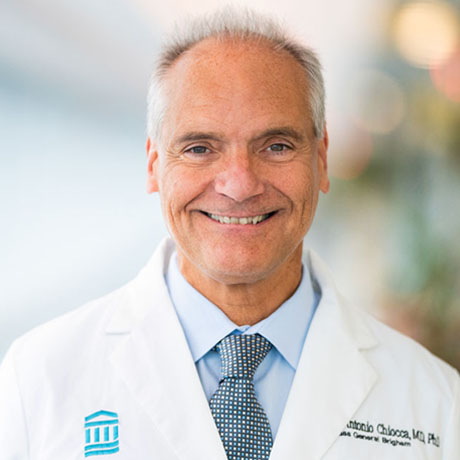
E. Antonio Chiocca, MD, PHD
Chair, Neurosurgery -
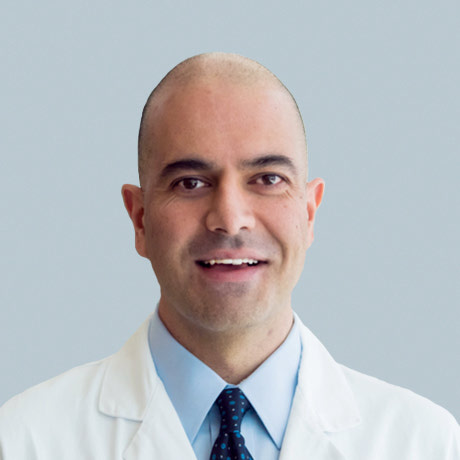
Brian V. Nahed, MD, MSc
Program Director
Clinical training
Our neurosurgical residents are exposed to high clinical volume, direct patient care and are expected to gain mastery of clinical and operative skills under the guidance of experienced attending neurosurgeons. It is essential that residents are exposed to each subspecialty in sufficient depth and breadth to become fully competent. Every trainee receives a focused experience in each of the main subspecialties, working in close conjunction with an expert senior attending physician who is a leader focused in brain tumor, vascular, functional, pediatric, peripheral nerve, skull-base or spine.
Neurosurgical training starts PGY-1 year with rotations in the NICU, neurosciences, pediatrics, and fundamental clinical skills training in the surgical sub-specialties of trauma and plastic surgery with general surgery. For full program details, including faculty, resident and alumni listings and information about the four clinical sites, view our program brochure:
Program overview
The intern year (PGY 1) provides a broad exposure to all neurosurgical disciplines, including tumor, vascular, trauma, functional, spine, pediatrics and neurocritical care. Residents in their elective years (PGY 4/PGY 5) perform laboratory-based research, pursue clinical fellowships, or obtain additional degrees.
| Subspecialty | PGY 1 | PGY 2/PGY 3 | PGY 4/PGY 5 | PGY 6/PGY 7 |
|---|---|---|---|---|
| Tumor | - | 3-4 months | Advanced rotation | Chief rotation |
| Vascular/Functional | Intro exposure | 3-4 months | Advanced rotation | Chief rotation |
| Spine | Intro exposure | Dedicated blocks | Advanced spine | Chief rotation |
| Pediatrics | Intro exposure | 4 months | Additional exposure | Senior rotation |
| Critical Care | 4 months | - | - | Senior oversight |
| Radiosurgery | Intro exposure | 4 months | Integrated exposure | Senior involvement |
Educational opportunities
Resident educational opportunities are an integral part of the program. Residents are encouraged to attend neurosurgical courses throughout their training in their chosen sub-specialty. The program encourages and sponsors residents to present their research at neurosurgery grand rounds and at national conferences including the American Association of Neurosurgical Surgeons, the Congress of Neurological Surgeons, and sub-specialty section meetings.
In addition, Mass General Brigham residents play an important role educating more junior colleagues and mentoring Harvard Medical Students and its AANS Chapter to host neurosurgical lectures, teach neuroanatomy, introduce surgical skills, and host monthly educational events.
Research opportunities
Residents are provided two years dedicated to research, clinical fellowship, or in pursuit of an advanced degree. Research opportunities in Boston are abundant and include those at the Brigham and Women’s Hospital (BWH), Boston Children’s Hospital (BCH), Massachusetts General Hospital (MGH), Dana Farber Cancer Institute (DFCI), Broad Institute, Wyss Institute, Harvard Medical School (HMS), Harvard School of Public Health, Harvard University (HSPH), and Massachusetts Institute of Technology (MIT).
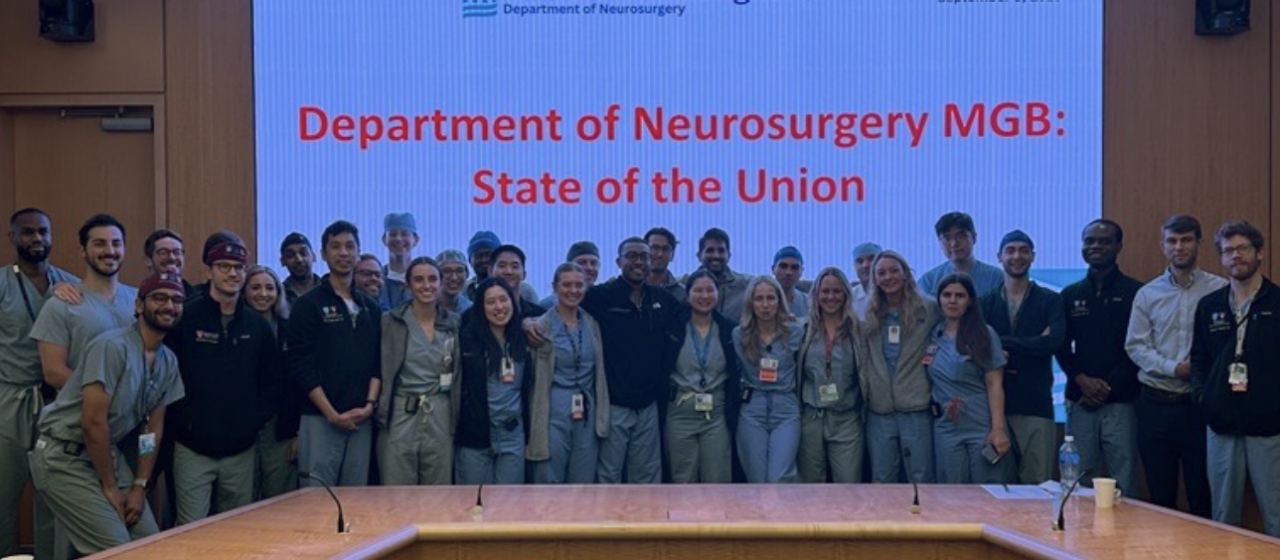
How to apply
Contact
E. Antonio Chiocca, MD, PhD, Department Chair
Brian V. Nahed, MD, MSc., Vice Chair of Education and Program Director
Wenya Linda Bi, MD, PhD, Site Director
Christopher Stapleton, MD, Site Director
John Chi, MD, MPH, Assistant Program Director
Bryan Choi, MD, PhD, Assistant Program Director
Kevin Huang, MD, Assistant Program Director
Ganesh Shankar, MD, PhD, Assistant Program Director
Katie Roche, MHA
Education Program Manager
617-726-5143 | kroche1@mgh.harvard.edu
Courtney Gilligan, MHA
Education Program Administrator
617-732-8719 | cegilligan@bwh.harvard.edu