What Are Adaptive Sports?
Keja MacEwan
Sarah Eby, MD, PhD
Athletes and fans around the world celebrate an inspiring milestone this year: the 50th anniversary of the Winter Paralympics. The opening ceremony of the Paralympics takes place on March 6, 2026 at the Arena di Verona in Italy, 2 weeks following the close of the Olympics at the same venue.
The Winter Paralympics showcase the world’s elite athletes in adaptive sports, bringing together more than 600 athletes from 56 countries. They compete in 79 medal events and 6 sports in Milano Cortina: Para alpine skiing, Para biathlon, Para cross-country skiing, Para ice hockey, Para snowboard and wheelchair curling. The athletes are fueled by years of dedication and training, culminating at the pinnacle competition of their sport.
“Many of the athletes, like their able-bodied counterparts, have dreamed of this day since they first said, ‘I want to be a Paralympian,’ says Keja MacEwan, director of Operations at Spaulding Rehabilitation Adaptive Sports Centers. “The growing visibility of the Paralympic movement is so important because it expands awareness of adaptive sport and may inspire that next young athlete to dream big, too.”
Sarah Eby, MD, PhD, a sports medicine specialist with Mass General Brigham and Spaulding Rehabilitation, serves as the head team physician for the U.S. Winter Paralympics alpine ski team and adaptive snowboarding team.
Para sports adaptations
Adaptive sports (also called para sports) are those with rules and equipment modifications that allow anyone to participate, especially those with some type of disability.
People with physical or visual impairments participate in adaptive sports that could one day lead to the Paralympics. Adaptive sports for people with cognitive impairments lead to the Special Olympics.
What are the different types of adaptive sports?
There are two types of competitive adaptive sports.
- Sports with the same general rules and timing as the sport for able-bodied competitors but are distinct and separate because of allowances for adaptive equipment, such as a wheelchair.
- Sports that are more inclusive, such as swimming or track-and-field, which can take place at the same events as those held for able-bodied athletes but have special races or divisions for those with disabilities.
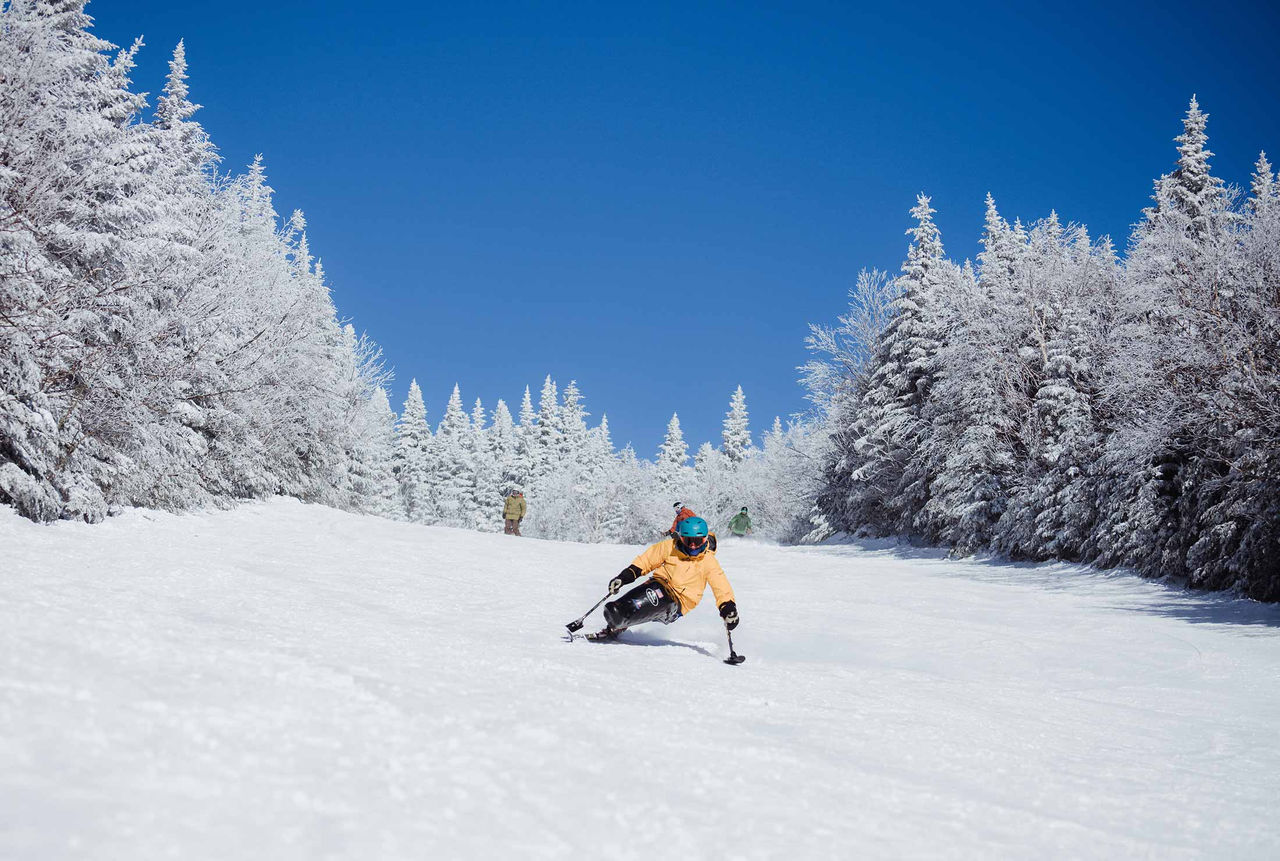
Adaptations for adaptive sports take on different forms. For example, adaptive cycling for people without use of their legs features bikes that can be pedaled by hand. In adaptive equestrian events, riders may use a riding crop to keep their horses moving instead of applying pressure with the legs. Adaptive skiing offers seated equipment with shocks to absorb terrain attached to a ski. The athlete uses outriggers in their hands instead of ski poles. In adaptive curling events, athletes throw the stones from wheelchairs and do not sweep the ice.
Some adaptive sports feature a range of physical-ability classifications. In adaptive swimming, class S9 is for athletes with joint restrictions in one leg or double below-the-knee amputations; class S10 is for swimmers with minimal impairments, such as the loss of a hand or a hip-joint restriction. In Para alpine skiing, the LW 1-4 classes refer to standing athletes with lower limb impairments, such as single below knee amputation (LW-4) or double above knee or equivalent impairment, such as moderate to severe cerebral palsy (LW-1). Visually impaired skiers are classified as a B1 (totally blind) to B3 (visual acuity of 2/6 to 6/60).
For children involved in adaptive sports, those benefits can be especially powerful fostering identity, empowerment, and sense of belonging, especially when they can do so with other adaptive athletes that share similar life stories.
Keja MacEwan
- Director of Operations at Spaulding Rehabilitation Adaptive Sports Centers
- Mass General Brigham
A growing adaptive sports movement
About 16% of the world population—an estimated 1.3 billion people—experiences a significant disability, according to the World Health Organization. That provides a sizable pool of potential participants in adaptive sports.
And the popularity of these sports continues to grow.
For many, participation starts in childhood. A study funded by the NCAA found more than 62,000 participants in youth adaptive sports programs across the United States, roughly half younger than 14 and half from 15 to 18. Because of the growth of the adaptive sport programs around the country, young athletes have the opportunity to play, train, and compete with each other.
“Sports play an important role in helping young people build relationships, strength, confidence, and life skills,” says MacEwan. “For children involved in adaptive sports, those benefits can be especially powerful fostering identity, empowerment, and sense of belonging, especially when they can do so with other adaptive athletes that share similar life stories. Too often, they are the ‘only one’ in their school. With adaptive sports, they can belong to a team.”
For others who’ve had life-changing injuries, returning to sports is a way to return to life. Chris Young was medically retired from the Coast Guard when he sustained a spinal cord injury in a plane crash in 1982. Two years later, his physical therapist introduced him to skiing.
“I made one right turn and one left turn and I had my life back,” Young says. “Para alpine skiing gives me a freedom of movement that my disability and wheelchair had taken away. I am able to forget my disability and allow sport and competition to take my focus.”
Young went on to compete in five Paralympics and has won two gold medals and two silver medals. He now serves as a Spaulding Adaptive Sports Centers volunteer, coach, and mentor.
Obstacles to participating in adaptive sports
Despite the growing interest and participation in adaptive sports, there are many common challenges people with disabilities face, including access to expert coaches and equipment.
Access to expert coaches
While Paralympic and adaptive sports are growing, the investment nationally is still limited. That means there are many underserved areas of the country.
“Athletes in New England thankfully benefit from a density of population, non-profits, local organization, governments, and others offering a variety of adaptive sport and recreational opportunities that overlap in services and regions,” says MacEwan. “But this isn’t true everywhere.”
Spaulding Adaptive Sports Centers offers a range of indoor and outdoor sport opportunities throughout the year to Spaulding patients and the general community.
“We can introduce a young athlete to new sport, like sled hockey, or help someone return to a sport, like tennis or golf, that they loved before an injury, and provide them with the adaptive equipment and training they need to participate and love it again,” says MacEwan.
Part of a nationwide network of adaptive sports programs, Spaulding Adaptive Sports Centers staff can refer athletes to other regional or national programs if they don’t offer what the athlete needs, or the athlete wants to train at a competitive level the centers don’t offer.
Access to equipment
For elite Paralympians, the right equipment—whether that’s a mono-ski designed for racing or a prosthetic leg geared for ski running—can cost thousands of dollars. Though the cost is less for adaptive sports athletes just starting out, it still can be prohibitive for many families. Money available through grants falls far short of meeting the total need, adds MacEwan.
Spaulding Adaptive Sports Centers, and the Massachusetts Department of Conservation and Recreation are examples of local organizations that provide free or low-cost access to a variety of adaptive sports, allowing people to experience a variety of sports and recreation. These programs provide a pathway to expose potential athletes to a sport. Spaulding Adaptive Sports Centers and the state agency often work together to provide accessible activities at state parks, pools, and rinks, and the programming features adaptive equipment, professional staff, and instruction and support.
The rewards of adaptive sports
Overcoming barriers to expert coaches and equipment can pave the path to success in adaptive sports and in life. In Chris Young’s case, that meant a 30-plus-year career on the U.S. Para Alpine Ski Team, two Paralympic gold medals (one in Slalom in 1994 and Super G in 2002) and two silver medals (in the Downhill in 2002 and 2006). He has coached numerous Paralympians, was inducted into the Adaptive Sports Hall of Fame in 2023, and is chair of the Para Sport Committee for the U.S. Ski and Snowboard Board of Directors.
Those who participate in adaptive sports often find some of the biggest long-term benefits off the field.
“Adaptive sports can be a launching point for so much more than competition—it builds confidence, problem-solving, and leadership that athletes carry into school, work, and community life,” says MacEwan. “We’ve made meaningful progress, but we still have work to do to ensure those pathways are truly open to every athlete with a disability.”