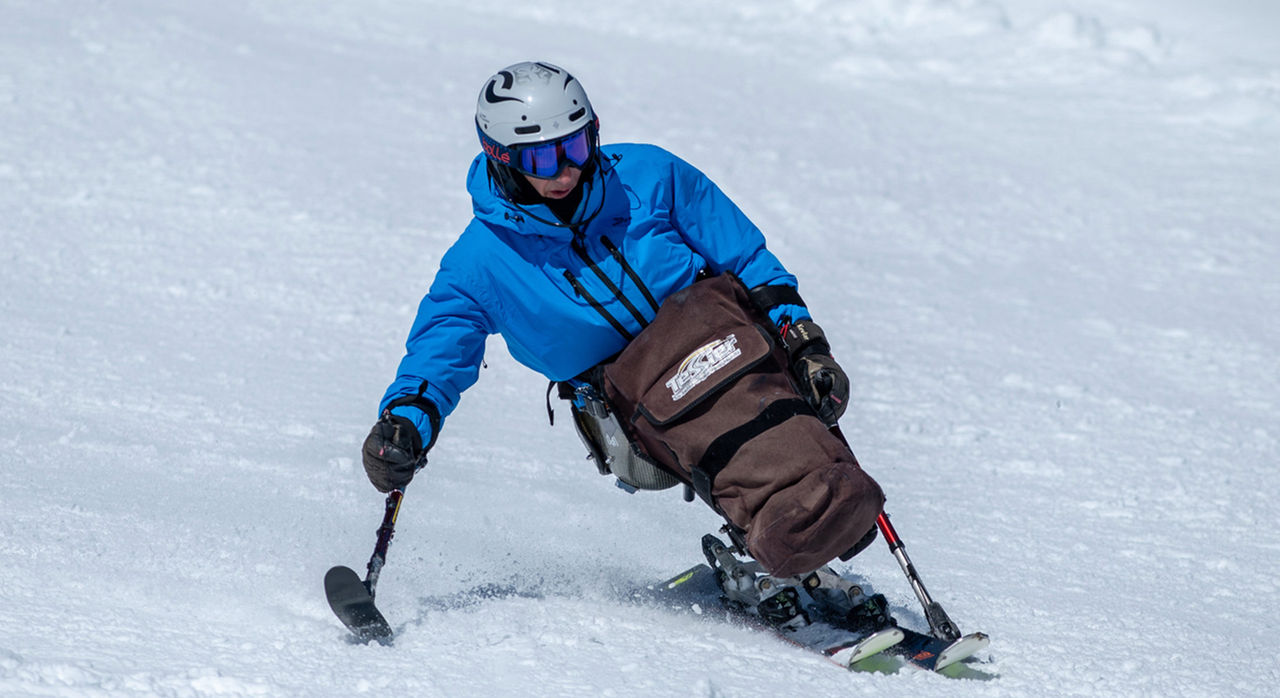
If you or someone you love has a physical disability, adaptive skiing can be a great way to stay active in the winter.
“Adaptive skiing uses modified ski equipment that helps people with physical disabilities safely enjoy time on the slopes,” says Sarah Eby, MD, PhD, a sports medicine specialist with Mass General Brigham and Spaulding Rehabilitation. Dr. Eby is the head team physician for the U.S. Winter Paralympics alpine ski team and adaptive snowboard team.
Adaptive skiing equipment
Adaptive skiing (also called para skiing) is a type of adaptive sport. People may participate in adaptive sports for fun or as athletes, such as those who train for and compete in Paralympic Games.
Adaptive skiing is similar to traditional downhill (alpine) skiing—but it allows for changes to equipment or rules. An adaptive skier may use:
- Communication systems: Adaptive skiers with visual impairments wear helmets with built-in two-way communication systems. This system allows an adaptive skier to communicate with their guide, who directs them down the slopes.
- Ski outriggers: A substitute for ski poles, outriggers have cuffs that go around a skier’s forearms and mini-skis instead of pointed tips on the ends. “Outriggers provide two additional points of contact with the snow, which helps an adaptive skier change direction and maintain balance,” says Dr. Eby. “Outriggers may be used by either standing or sitting skiers.”
- Tip stabilizers: This clamp or bungee cord-like device connects the tips of skis. Also called tip clamps or ski bras, the device keeps skis parallel so they can’t cross. Tip stabilizers give adaptive skiers greater control and stability. They can be especially helpful when one side of an adaptive skier’s body is stronger than the other.
- Mono - or bi-skis: These are types of sit-skis that allow a person without use of their legs to ski while sitting down. They consist of a ‘bucket’ seat connected to a structural spring or shock system that’s mounted to a snow-ski. For mono-skis, the snow ski is identical to able-bodied skis and are skied independently. Bi-skis have modified snow skis.
Adaptive skiing methods
There are several different ways for an adaptive skier to get down a mountain. Common types of adaptive skiing include:
- Two-track (2T) adaptive skiing: This type is the most similar to traditional skiing. You ski with each leg on a separate ski and use ski poles. Adaptive devices like tip stabilizers help with balance, speed, and turning.
- Three-track (3T) adaptive skiing: A skier with one leg uses a single ski. They hold an outrigger in each hand to aid balance.
- Four-track (4T) adaptive skiing: This approach is similar to 2T adaptive skiing, except the skier uses two outriggers instead of ski poles.
- Sit skiing: A sit ski has a bucket seat mounted on one ski (monoski) or two skis (bi-ski). A skier sits in the seat and uses outriggers to control movement and balance. A built-in shock absorber cushions the ride. Mono-skiing is an independent type of skiing using hand-held outriggers. Bi-skiing is more often a collaboration between the adaptive skier and a partner/instructor assisting with the bi-ski movements through the use of tethers. Depending on the ability of the bi-skier, they may use hand-held outriggers or outriggers may be affixed to the bi-ski.
When you’re on the slopes, you’re immersing yourself in nature, breathing in crisp air, and spending time with others who support you.
Sarah Eby, MD, PhD
- Sports Medicine Specialist
- Mass General Brigham
Benefits of adaptive skiing
Skiing is a great outdoor winter workout that’s good for your physical and mental health. “When you’re on the slopes, you’re immersing yourself in nature, breathing in crisp air, and spending time with others who support you,” says Dr. Eby.
Risks of adaptive skiing
Like traditional skiing, adaptive skiers can experience common ski injuries, such as:
- ACL tears
- Concussions
- Knee injuries
“Adaptive skiers may be slightly more prone to shoulder injuries because they rely more heavily on their upper bodies,” says Dr. Eby. Proper training, including strength training and staying physically active in the winter, can help prevent ski injuries.
Getting started in adaptive skiing
Like traditional skiing, it takes time and practice to learn how to ski with modified equipment. Because adaptive ski equipment can be pricey, Dr. Eby recommends trying out different options before buying, as well as taking lessons.
To get started:
- Sign up for adaptive ski lessons at Spaulding Adaptive Sports Centers. They also offer a wide range of equipment to try.
- Check out the Massachusetts Department of Conservation and Recreation’s Universal Access Program (UAP) for free or low-cost access to adaptive ski equipment and instruction.
- Contact Move United, a nonprofit organization that supports all types of adaptive sports programs throughout the country.
- Call your local ski resort and ask about adaptive ski programs.
Learn about Mass General Brigham Sports Medicine services
Para skiing at the Winter Paralympics
Para alpine skiing became part of the Paralympic Winter Games™ in 1976. The 2026 Paralympic Winter Games, which take place March 6 to March 15 in Milano Cortina, Italy, feature five para ski events. There are three adaptive ski categories: standing, sitting, and vision impaired. Each event uses a timing correction system that ensures fair competition among athletes with different types and levels of disabilities.
The five para alpine ski events include:
- Downhill: The downhill is the in the longest and fastest course, often at speeds in excess of 60 to 70 m.p.h., navigating around set get gates (poles). Each skier completes the course once. The fastest skier wins.
- Slalom: A skier makes sharp turns between closely spaced gates on a short course. They compete on two different courses on the same day. The times for each run are added together. The winner is the one with the fastest total combined time.
- Giant slalom: Skiers race between gates spaced farther apart than in slalom, but closer than in super-G. Similar to slalom, each skier competes on two different courses on the same day. A skier’s scores are combined to determine a winner.
- Super-G: Short for super-giant slalom, this race combines the speed of downhill with the turns of a slalom. The course is longer than a slalom or giant slalom with closely spaced gates. Each skier completes the course once. The fastest racer wins.
- Super combined: A skier completes a high-speed event (either downhill or Super-G) and also completes a single slalom run. The skier with the fastest combined time wins.
“Para alpine skiing events are thrilling to watch and so inspiring,” says Dr. Eby. “These athletes don’t let physical limitations stop them from doing what they love. I encourage everyone to watch the 2026 Winter Paralympic Games.”