When Colon Cancer Strikes Early: A Young Woman’s Journey to Remission
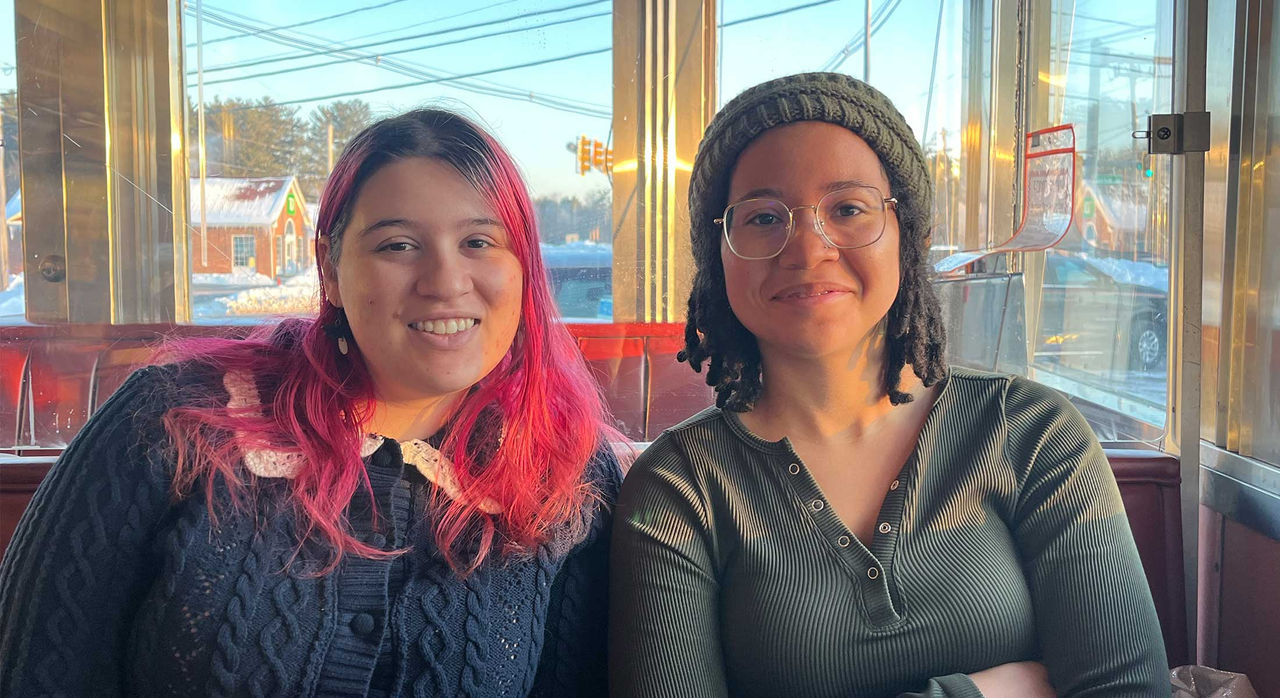
As a 21-year-old looking forward to her junior year at the University of Massachusetts Amherst, Claudia Umanita wasn't worried about cancer. She was busy enjoying her college years and working toward the future she envisioned. But then, as is the case with more and more young adults today, cancer entered the picture.
Claudia had been referred to Mass General Brigham Cancer Institute at Massachusetts General Hospital to remove a mass that was blocking her colon. During the operation, the surgeon took a small sample of colon tissue. A subsequent analysis found that Claudia had colon cancer.
"When it turned out to be cancer, my family and I were completely caught off guard," she said. "That was some crazy news. Just a shock."
Thanks to the care Claudia received at Mass General Brigham Cancer Institute, including through the Center for Young Adult Colorectal Cancer, her cancer is now in remission. Though still dealing with emotional and psychological scars, she is looking to the future with optimism and excitement once again.
An alarming rise in colorectal cancer cases
Sadly, cases like Claudia's are becoming increasingly common. Colorectal cancer rates are climbing sharply in people under the age of 50. In fact, colorectal cancer is now the leading cause of cancer deaths among both men and women in this age group. Colorectal cancer refers to cancer that starts in the colon (also called colon cancer) or the rectum (also called rectal cancer).
Medical oncologist Aparna Parikh, MD, medical director of Mass General Brigham Cancer Institute's Center for Young Adult Colorectal Cancer and program director of the Gastrointestinal Oncology Program, said the growing numbers of young people with colorectal cancer is likely due to multiple factors.
"Obesity, less physical activity, processed food and red meats, refined grains, alcohol, and the changing microbiome are all contributors to chronic inflammation in the colon," Dr. Parikh said. "It's that chronic inflammation that we think may ultimately be leading to this."
The mission of the Center for Young Adult Colorectal Cancer is to address the vast unmet needs of patients under 50 with colorectal cancer through specialized, personalized care. Its team includes medical oncologists, radiation oncologists, and gastrointestinal surgeons as well as advanced practice providers, nurses, gastroenterologists, radiologists, genetic counselors, and other healthcare professionals.
As Claudia learned, this multidisciplinary expertise is crucial to optimizing patient outcomes.
Surgery takes an unexpected turn
Claudia first visited an emergency room (ER) near her family's home in Rowley, Massachusetts, after experiencing stomach pain for a few weeks. Her care team took X-rays and concluded she was just constipated. She went home but returned to the ER several days later when her symptoms didn't go away.
This time, a CT scan revealed a mass in her colon, which doctors thought might be a cyst or polyp. She was transferred to Mass General for surgery to remove it.
During the operation, Mass General Brigham colon and rectal surgeon Hiroko Kunitake, MD, MPH, discovered the mass was too big to take out. As a result, she instead connected a healthy part of the small intestine to an opening in the stomach. This opening is known as a stoma. Waste passes through the stoma into a colostomy bag (a pouch worn on the belly).
The news was a lot for Claudia to take in after she woke up. A few days later, Dr. Kunitake told her she had colon cancer. It was an extremely difficult period.
"The doctors had thought I might have ulcerative colitis or Crohn's disease. Finding out it was cancer was very tough for my family and me," she said. "Beyond that, having the colostomy bag was a huge adjustment. And I couldn't eat solid foods—I could only have clear liquids or nutrients via an IV (intravenous line).
"It didn't feel real. It felt more like a bad dream."
Treatment plan calls for chemotherapy and surgery
A few days after receiving the colon cancer diagnosis, Claudia met with Dr. Parikh for the first time. Dr. Parikh reviewed the treatment plan, which she had worked on with Dr. Kunitake. Claudia would need chemotherapy as well as surgery to remove the cancer.
Dr. Parikh also explained that the chemo might make it hard for Claudia to have children later on. So, following a consultation with a Mass General fertility specialist, Claudia agreed to undergo egg retrieval. The eggs were frozen in case she needs in vitro fertilization to conceive one day.
"It was kind of a surreal experience to have at 21," she said.
Claudia was discharged eight days post-surgery and returned to UMass Amherst. A week later, she started her chemo treatments.
Every other week, she followed the same routine: On Friday, she drove to her family's home. The next morning, one of her parents took her to Mass General, where one drug was infused via an IV over the course of four hours. Then, she went back to her family's home with an infusion pump that delivered a slow, steady dose of the second drug over a 36-hour period. On Sunday, she returned to Mass General to have the pump disconnected. From there, she headed back to Amherst.
Claudia tolerated the chemo pretty well. She was tired and had some nausea but didn't lose any hair. Somehow, she managed to continue working as a teaching assistant while taking a full courseload and getting straight A's.
"I'm a psychology major with a biology minor and love what I'm studying," she said. "School helped me feel like I was a person beyond the diagnosis. It was a great distraction."
Wrapping up her chemo treatments
As Claudia neared the halfway point of her chemo treatments, she agreed with the assessment of Drs. Kunitake and Parikh that the time was right for a second surgery. Besides removing the cancerous mass, Dr. Kunitake reconnected the colon to the small intestine and closed the stoma. Claudia would no longer need a colostomy bag.
While she recovered from surgery, Claudia took time off from school—and, with Dr. Parikh's blessing—from her chemo treatments. Soon after starting again, she went into anaphylaxis (a severe, life-threatening allergic reaction) while receiving an infusion at Mass General.
"It was a terrifying experience, but the chemo nurses responded right away," she said.
"Over time, it's not unusual for people to become allergic to one of the chemotherapy meds, and that's what happened to Claudia," Dr. Parikh added. "We had to get an allergist involved to help ensure she could finish the recommended chemotherapy safely."
For each of the final four rounds of chemo, Claudia received a diluted version of the drug over the course of eight to 12 hours. Each time, she stayed at Mass General for three days.
Eight months after being diagnosed with colon cancer, Claudia concluded her 12th—and final—round of chemo. Per tradition, she rang the bell at Mass General to mark the end of her cancer treatment.
But her recovery was not yet complete.
I truly had the best support system—Dr. Parikh and her nurse practitioner, Aralee Galway; Dr. Kunitake; the folks in fertility; my chemo nurses; and so many others. I couldn't have asked for a better patient experience.
Claudia Umanita
- Patient
Attuned to the needs of young people with cancer
Dr. Parikh noted that young people with cancer have much different needs than older people with cancer. The team at the Center for Young Adult Colorectal Cancer is keenly attuned to these nuances.
"Our people and the services we offer aim to address the concerns that are at the forefront in this stage of life, like sexual health, fertility, and genetic counseling," Dr. Parikh said.
Upon finishing her cancer treatment, Claudia felt lost, anxious, and isolated. For months, she had been focused solely on her health. She hadn't had the opportunity to process what she was going through.
Many of Dr. Parikh's patients choose to see the social worker who is part of the team at the Center for Young Adult Colorectal Cancer. Since Claudia spends the school year in Amherst, however, she's been seeing a local psychiatrist instead.
"Remission has actually been harder mentally than going through treatment was," she said. "Therapy has been really helpful in terms of adjusting to my new life and figuring out how to avoid worrying so much about the future of my health."
Just a few months from graduation, Claudia hopes to work for a couple years and then earn a PhD. Long term, she'd like to work with teens and adults with autism and attention deficit hyperactivity disorder.
Dr. Parikh is pleased that Claudia has come so far. "I think the multidisciplinary care Claudia received at Mass General Brigham Cancer Institute has played a big role," she said. "So many specialties were involved—medical oncology, surgery, fertility, allergy. She touched a lot of people within the system."
Claudia appreciates the efforts and commitment of her entire Mass General Brigham Cancer Institute care team.
"I truly had the best support system—Dr. Parikh and her nurse practitioner, Aralee Galway; Dr. Kunitake; the folks in fertility; my chemo nurses; and so many others," she said. "I couldn't have asked for a better patient experience."
A young woman with vibrant pink hair and a dark coat is seen standing outside on a snowy night.
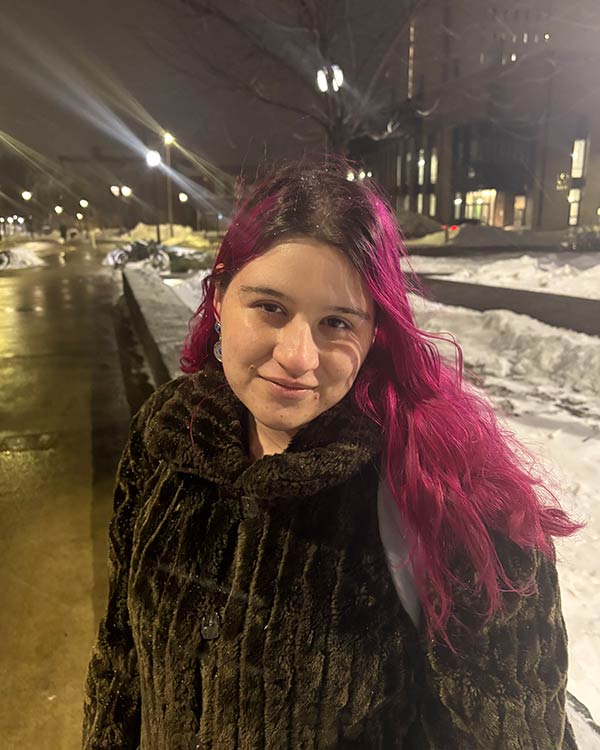
Now in remission, Claudia is looking forward to the future as she continues her recovery.